
 Kontakt
 Wie einkaufen
Versand
Kaufberater
 Englisch
 26 b
26 b
 Neu
Neu
Bis zu 30 Tage Rückgaberecht

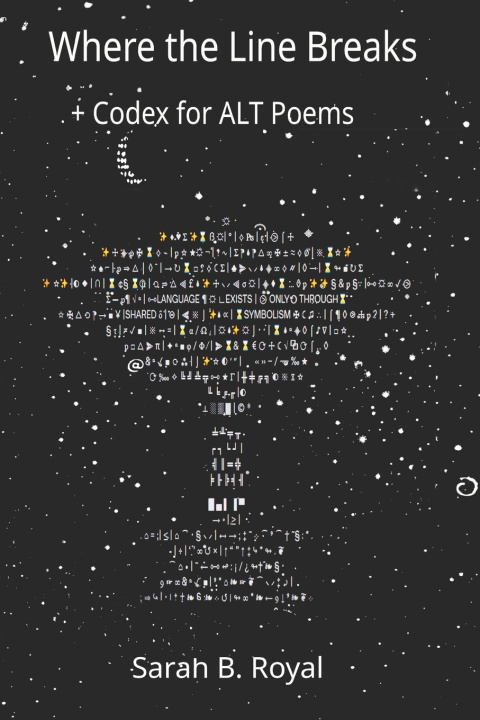
Where the Line Breaks: + Codex for ALT Poems is a groundbreaking collection that reimagines poetry through symbolic logic, visual structure, and semantic innovation. Blending concrete layout with a personal ALT/Unicode codex, this work transforms the page into a compositional field where symbols act as operators-carrying meaning through spatial arrangement, recursion, and visual rhythm rather than conventional narrative to explore interpersonal relationships. Poetic fragments collapse into glyphic patterns; operator sequences such as arrows, cycles, and logical markers become the engine of semantic transformation; and the interplay of ALT and Unicode symbols invites readers into a new lexicon of poetics grounded in both medieval scribal tradition and contemporary typographic experimentation. Where the Line Breaks challenges assumptions about how language works and offers a richly layered experience for readers interested in the edge where structure and meaning intersect and fall apart.
This collection also draws from concrete and visual poetry, where the page becomes a compositional field. Typography, spacing, mirroring, stacking, compression, and capitalization operate as primary structural forces. Letters become spatial events. Orthography performs intensity rather than grammar. The poem is apprehended visually as well as sequentially. In developing some of these poems, I was encouraged by Igor V. Satanovsky's The Щymmetry Studies (2026), a poem-sequence examining symmetry, instability, and operator relations as compositional forces. His investigations into asymmetry and structural drift prompted me to extend ALT symbols further into concrete and quantum poetics. The ALT Poetry Codex itself was not derived from his system; however, aspects of symbolic symmetry and operator instability were sharpened in dialogue by his theories. Readers may also situate this influence within one strand of quantum poetics developed by Satanovsky, part of his broader Quantum Poetics and Quantum Age Poetry project.


Informationen zum Buch
Englisch
