
 Kontakt
 Wie einkaufen
Versand
Kaufberater
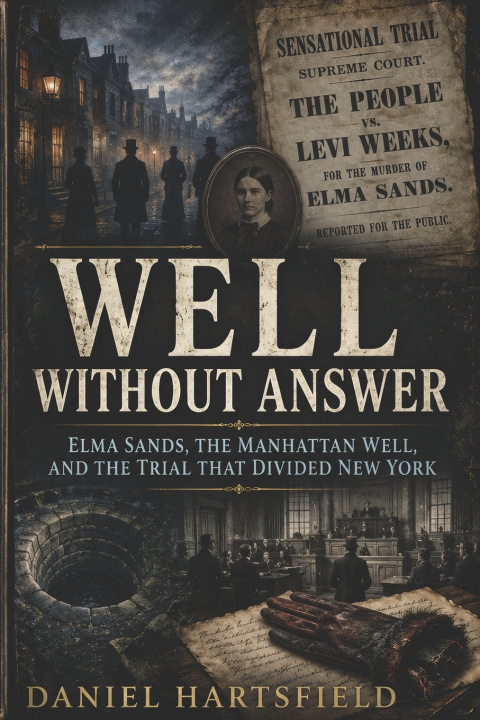
Well Without Answer
Elma Sands, the Manhattan Well, and the Trial That Divided New York
 Englisch
 44 b
44 b
 Demnächst
 Neu
Neu
Bis zu 30 Tage Rückgaberecht

A young woman vanished from a crowded Manhattan boarding house. Eleven days later, the well returned her-and the city demanded an answer.
On December 22, 1799, Gulielma "Elma" Sands, about twenty-two, disappeared from the Ring boarding house on Greenwich Street. Her body was recovered from the Manhattan Well on January 2, 1800. Suspicion settled on fellow boarder Levi Weeks, who was indicted for murder, pleaded not guilty, and was acquitted after a brief jury deliberation. The verdict ended the prosecution against Weeks. It did not explain how Elma entered the well or whose actions caused her death.
Well Without Answer is a restrained work of historical true crime and narrative nonfiction that returns Elma Sands to the center of a case often remembered for its courtroom spectacle, famous attorneys, and urban legend. Drawing on the surviving published trial report and supporting historical sources, it follows the known chronology while separating confirmed fact from testimony, allegation, inference, and later speculation.
The book reconstructs the watched rooms of the Greenwich Street household, Elma's reported expectation of a secret marriage, the uncertain sounds at the door, a disputed street sighting, cries heard from the fields, the borrowed muff found near the well, and the sleigh evidence used to build the state's circumstantial chain. Each detail is tested against what witnesses actually saw, heard, remembered, or concluded.
Inside the courtroom, medical witnesses disagreed about marks on Elma's body, possible violence, and what drowning could establish. The prosecution argued that the fragments formed a coherent path from the boarding house to the well. The defense attacked the missing links: no eyewitness to a departure together, uncertain timing, contested physical evidence, and a city already pressing toward conviction. Alexander Hamilton, Aaron Burr, and Brockholst Livingston stood for the defense, but the moral center of the story remains the woman whose voice reached the record only through others.
Beyond the trial, the narrative places the Manhattan Well within New York's struggles over water, disease, growth, reputation, and public power at the turn of the nineteenth century. It also traces how pamphlets, public anger, legal memory, and later folklore transformed an unresolved death into a legend-often making the well and the celebrated men easier to remember than Elma herself.
Written in an evidence-aware, victim-centered style, the book refuses to name an offender where the surviving record cannot support one. It examines the prosecution theory, the defense alternatives, the limits of hearsay and medical certainty, and the difference between an acquittal, public suspicion, and historical truth. A detailed timeline, key-people glossary, and source index support readers who want to follow the case beyond the narrative.
For readers drawn to historical true crime, early American legal history, unresolved historical deaths, courtroom evidence, and old New York, Well Without Answer offers no manufactured solution. It preserves the record, tests the stories built around it, and asks why Elma Sands still matters more than the answer history failed to provide.


Informationen zum Buch
Englisch

Verschenken Sie dieses Buch noch heute
Es ist ganz einfach
1 Legen Sie das Buch in Ihren Warenkorb und wählen Sie den Versand als Geschenk 2 Wir schicken Ihnen umgehend einen Gutschein 3 Das Buch wird an die Adresse des beschenkten Empfängers geliefertHallo! Ich bin Libroamiko, dein Buchberater.
Wie kann ich dir helfen?