
 Kontakt
 Wie einkaufen
Versand
Kaufberater
Waste as Resource
Rethinking Scenic Design Through Biomimicry For A Sustainable Ecology.DE
 Englisch
 73 b
73 b
Bis zu 30 Tage Rückgaberecht

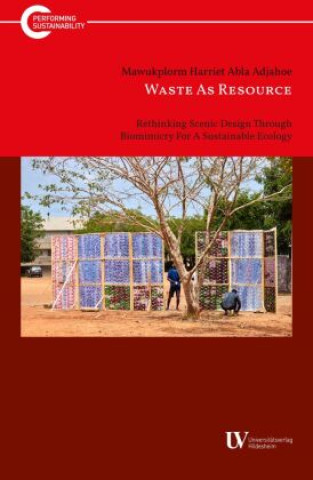
This research investigates the potential of waste materials as viable resources for scenic design in theatre, using biomimicry and circular economy principles to promote sustainable ecological practices. Set against the backdrop of intensifying environmental degradation in Ghana-particularly deforestation and plastic waste pollution-the study critiques the continued reliance on virgin timber and other non-renewable materials in set construction. It proposes an alternative paradigm rooted in eco-design, where nature serves not only as metaphor but also as a model for sustainable innovation.The study is anchored in three intersecting theoretical frameworks: the theory of Circular Economy (CE), biomimicry, and cultural sustainability. CE informs the material logic of the research, emphasizing the need to maintain resource value by closing production-consumption loops. Biomimicry provides the design strategy, advocating for solutions that emulate nature's efficiency, adaptability, and regenerative capacity. Cultural sustainability grounds the research in context, ensuring that design approaches remain locally relevant and socio-culturally embedded.A practice-led, arts-based methodology was employed, incorporating qualitative data from interviews with Ghanaian set designers, observations of production processes, and the researcher's own creative experiments. These were complemented by a design-led inquiry in which waste plastics-particularly PET, LDPE, and polypropylene-were reprocessed and reimagined using biomimetic principles drawn from natural architectures such as the spider webs. The practical component culminated in a full-scale scenic design for the play The Marriage of Anansewa, integrating these reconfigured waste materials in both symbolic and structural functions.The findings indicate that sustainable set design using repurposed waste is both feasible and artistically expressive. However, material outcomes were highly contingent on technological capacity. For instance, thermoplastic reshaping via open-air melting was found to pose significant health and environmental risks due to toxic emissions. Safer methods-such as mechanical compression and cold assembly using PET bottles and LDPE sachets-proved more effective within low-tech contexts. These findings underscore the need for localized, technology-appropriate strategies in CE implementation.Importantly, the research demonstrates that integrating circular and biomimetic thinking into theatre practice can generate new aesthetic languages while aligning with the UN Sustainable Development Goals, particularly Goals 12 (Responsible Consumption and Production), 13 (Climate Action), and 15 (Life on Land). A "Waste Designing Model" is proposed, outlining a systematic process for designers to assess, acquire, transform, and reintegrate waste materials within theatrical production cycles. The model emphasizes modularity, reversibility, and lifecycle awareness.The study concludes that rethinking scenic design through the lenses of biomimicry and circular economy not only advances environmental stewardship in the performing arts, but also contributes to epistemological shifts in design thinking in the Global South. Scenic designers are thus repositioned as both creative agents and sustainability practitioners-capable of transforming theatre into a living laboratory for ecological innovation, cultural resilience, and climate-conscious storytelling.


Informationen zum Buch
Englisch

Verschenken Sie dieses Buch noch heute
Es ist ganz einfach
1 Legen Sie das Buch in Ihren Warenkorb und wählen Sie den Versand als Geschenk 2 Wir schicken Ihnen umgehend einen Gutschein 3 Das Buch wird an die Adresse des beschenkten Empfängers geliefertHallo! Ich bin Libroamiko, dein Buchberater.
Wie kann ich dir helfen?