
Werden Sie Teil einer Gemeinschaft von Buchliebhabern aus der ganzen Welt und erhalten Sie eine Reihe von Vorteilen.
Konto kostenlos anlegen
DPD-Kurier 4.49 €
Hermes Kurierdienst 4.99 €
DHL-Kurier 3.99 €
Hermes-Stelle 4.49 €
DPD-Stelle 2.99 €
GLS-Kurierdienst 4.99 €
 Kontakt
 Wie einkaufen
Hilfe
Versand
DPD-Kurier 4.49 €
Hermes Kurierdienst 4.99 €
DHL-Kurier 3.99 €
Hermes-Stelle 4.49 €
DPD-Stelle 2.99 €
GLS-Kurierdienst 4.99 €
Kaufberater
Mein Konto
▸
Leer :-(
0
To Pharmacy or Not to Pharmacy
Sprache
 Englisch
Englisch
Buch
Broschur
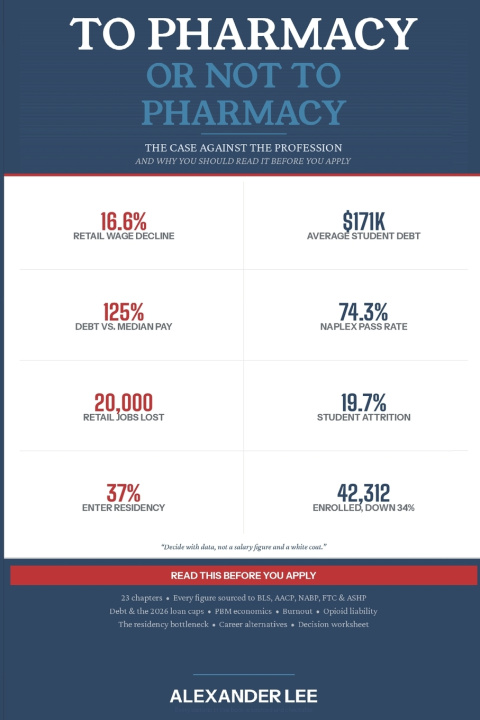
The brochure will tell you pharmacists earn a median of $137,210. It will not tell you the average g...
Vollständige Beschreibung
Libristo-Code: 53566810
?
 38 b
38 b
 Demnächst
 Neu
Neu
38 b
Demnächst
Neu
15.59
€
inkl. MwSt.
Erwartete Einlagerung
Veröffentlichung 24. 08. 2026
Bis zu 30 Tage Rückgaberecht

The brochure will tell you pharmacists earn a median of $137,210. It will not tell you the average graduate owes $171,000 before their first shift.
Pharmacy school admissions offices, professional associations, and career websites already make the case for the profession. They are well funded and well practiced at it. This book makes the case against - not because it is the only truth, but because it is the truth prospective students are least likely to encounter before they sign a promissory note.
Across twenty-three chapters of federal data, peer-reviewed research, and firsthand testimony, To Pharmacy or Not to Pharmacy documents what the recruitment materials leave out:
- Retail pharmacist wages fell 16.6% between 2012 and 2022, while hospital wages fell just 2.5%
- The first-time NAPLEX pass rate collapsed from roughly 95% to 74.3% as schools expanded and applicants disappeared
- Retail pharmacy shed about 20,000 pharmacist positions between 2023 and 2025 - while the growth went to hospital roles gated behind a residency only 37% of graduates obtain
- Student attrition hit 19.7% in 2024, the highest rate this century
- Enrollment fell from 63,927 in 2014 to 42,312 in 2024
- Graduate PLUS loans ended July 1, 2026 - and the average private pharmacy school graduate now owes more than the federal government will lend
You will also find a chapter on the opioid settlements and the liability individual pharmacists still carry, an honest comparison of pharmacy against PA, NP, and MD paths, a guide to the practice settings that still work, and a six-question worksheet to complete before you apply.
Every figure is sourced. BLS, AACP, NABP, FTC, DEA, ASHP, peer-reviewed journals, and federal court records. Every number can be checked.
Written by a licensed pharmacist and attorney who has authored two books on the 340B Drug Pricing Program.
If this book convinces you not to pursue pharmacy, it may have saved you $171,000 and four years. If it convinces you to pursue pharmacy anyway - with open eyes and a realistic plan - it may have saved you something more valuable: the particular despair of discovering the truth after it is too late to act on it.
Schauspielerin
&
Polyglotte
EWA KASP
für
Video abspielen


Libristo bietet die größte Auswahl an fremdsprachiger Literatur an. Deshalb kaufe ich meine Bücher hier ein.
Informationen zum Buch
Vollständiger Name
To Pharmacy or Not to Pharmacy
Autor
Alexander Lee
Sprache
Englisch
Englisch
Einband
Buch - Broschur
Datum der Veröffentlichung
2026
Anzahl der Seiten
228
EAN
9798193502609
Libristo-Code
53566810
Verlag
Independently published
Gewicht
312
Abmessungen
152 x 229 x 13
