
 Kontakt
 Wie einkaufen
Versand
Kaufberater
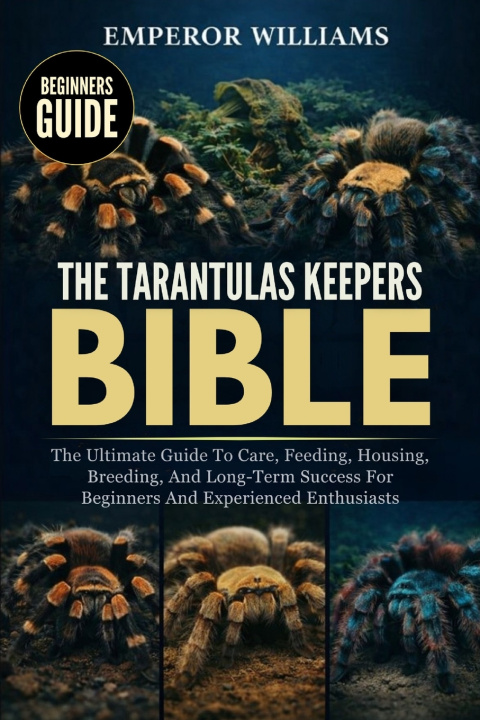
THE TARANTULAS KEEPERS BIBLE
The Ultimate Guide To Care, Feeding, Housing, Breeding, And Long-Term Success For Beginners And Experienced Enthusiasts
 Englisch
 38 b
38 b
 Neu
Neu
Bis zu 30 Tage Rückgaberecht
Kunden kauften auch
 /
/
 Broschur
 10.09
€
10.09
€





Introduction to Tarantulas
Tarantulas, one of the most fascinating groups of arachnids, have captured human imagination for centuries. Their imposing size, striking coloration, and enigmatic behavior make them not only intriguing subjects of scientific study but also highly sought-after pets among exotic animal enthusiasts. Despite their fearsome reputation, tarantulas are remarkably resilient, low-maintenance, and quietly captivating creatures.
History and Evolution of Tarantulas
Tarantulas belong to the family Theraphosidae, a lineage that has existed for over 100 million years, dating back to the Cretaceous period. Fossil evidence shows that tarantulas have remained remarkably consistent in their general body structure throughout evolutionary history. Unlike many other arachnids, they have retained their large, robust bodies, powerful fangs, and hairy exteriors that serve multiple functions, from sensing vibrations to deterring predators.
The name "tarantula" has an interesting history. It originally referred to a spider found near the Italian city of Taranto. In medieval Europe, these spiders were associated with a mysterious illness called "tarantism," thought to be caused by the spider's bite. The "cure" for tarantism often involved frenzied dancing, which became a cultural phenomenon known as the tarantella. Over time, the term "tarantula" became generalized, eventually being applied to large, hairy spiders of the Theraphosidae family worldwide, regardless of whether they were related to the original European species.
Tarantulas are remarkable in their adaptability. They can be found on nearly every continent except Antarctica, thriving in diverse environments ranging from dense tropical rainforests to arid deserts and scrublands. Their evolutionary success is attributed to a combination of characteristics: their nocturnal lifestyle, burrowing behavior, and generalist predatory habits. These spiders are highly effective hunters. Unlike web-spinning spiders that rely on passive prey capture, tarantulas actively stalk and ambush their prey, employing potent venom to subdue insects, small mammals, reptiles, and other arthropods.
Over millions of years, tarantulas have diversified into hundreds of species. This diversification has been driven by geographic isolation, climate shifts, and ecological niche specialization. Each species exhibits unique adaptations, from vivid coloration and urticating hairs in New World species to formidable size and striking hunting behaviors in Old World tarantulas. Evolution has also favored reproductive strategies such as producing hundreds of eggs per sac, increasing the likelihood of species survival despite predation and environmental challenges.
Overview of Tarantula Diversity
The family Theraphosidae is incredibly diverse, encompassing more than 1,000 recognized species across approximately 150 genera. Tarantulas are generally divided into two main groups: New World tarantulas and Old World tarantulas. This classification is not merely geographic; it also reflects behavioral and morphological differences.
New World Tarantulas: Found primarily in the Americas, these tarantulas are known for their relatively docile nature and the presence of urticating hairs. Urticating hairs are specialized bristles located on the abdomen that the spider can flick toward potential threats, causing irritation to predators and deterring attacks. New World species often display striking color patterns, including vibrant greens, blues, and reds. Examples include the Greenbottle Blue (Chromatopelma cyaneopubescens), the Mexican Redknee (Brachypelma smithi), and the Brazilian Black (Grammostola pulchra).
Old World Tarantulas: Native to Africa, Asia, and parts of Europe, Old World tarantulas lack urticating hairs but are often more defensive and possess potent venom relative to their New World counterparts.


Informationen zum Buch
Englisch

Verschenken Sie dieses Buch noch heute
Es ist ganz einfach
1 Legen Sie das Buch in Ihren Warenkorb und wählen Sie den Versand als Geschenk 2 Wir schicken Ihnen umgehend einen Gutschein 3 Das Buch wird an die Adresse des beschenkten Empfängers geliefertHallo! Ich bin Libroamiko, dein Buchberater.
Wie kann ich dir helfen?