
 Kontakt
 Wie einkaufen
Versand
Kaufberater
 Englisch
 40 b
40 b
 Neu
Neu
Bis zu 30 Tage Rückgaberecht

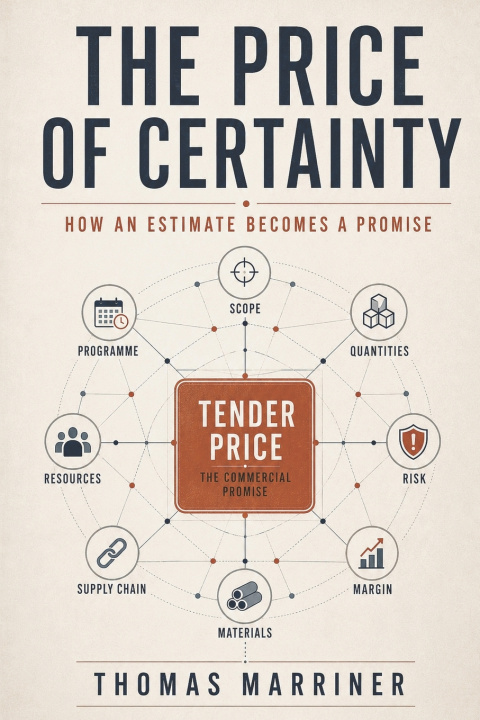
What does a fixed construction price actually mean when the project has not been built, much of the design is still developing, the supply chain has not been fully appointed and the economy is still moving?
That is the question at the heart of The Price of Certainty.
Every day, construction asks estimators to put precise numbers against an uncertain future. Those estimates become tenders. Tenders become contracts. And eventually a contractor is expected to stand behind a promise made months or years before the true cost of delivering it can be known.
This book explains what happens in between.
Thomas Marriner takes the reader inside the commercial machinery of modern construction: how an estimate is assembled, how competition changes the number, why a subcontract quotation is not the same as a purchase, how contractors buy fragmented specialist capability beneath a single client-facing commitment, and how risk, margin, cash flow, working capital and financial capacity determine whether that commitment can actually be carried.
Along the way, The Price of Certainty explains why the lowest tender is not necessarily the cheapest outcome, why a fixed price does not make the future fixed, how contractors can sell before everything underneath them has been bought, why cash is not profit, how market movements eventually arrive on site, and why different procurement models do not remove uncertainty - they decide when it is confronted, who carries it and how it is paid for.
This is not simply a book about estimating. It is an explanation of the economics of the modern construction industry, viewed through the point where clients, contractors, subcontractors, markets and money meet.
It is written for estimators, quantity surveyors, commercial managers, project managers, contractors, clients, developers, consultants and construction professionals who want to understand not only how prices are produced, but what those prices really represent.
If you have ever wondered why two competent contractors can price the same project differently, where contractor margin really comes from, why procurement choices change commercial behaviour, or what a client is actually buying when it asks for "cost certainty", this book provides the missing picture.
Construction cannot make the future certain. It can only decide who is prepared to stand behind a promise despite it.


Informationen zum Buch
Englisch
Kategorie
