
 Kontakt
 Wie einkaufen
Versand
Kaufberater
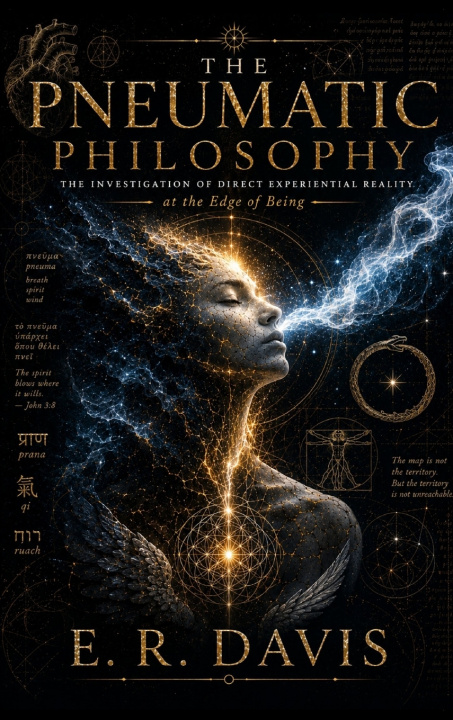
The Pneumatic Philosophy
 Englisch
 56 b
56 b
 Demnächst
 Neu
Neu
Bis zu 30 Tage Rückgaberecht

Every serious inquiry, pushed to its limit, ends at the same edge. This book is about why.
The Pneumatic Philosophy is the second work in E. R. Davis's project of Pneumatic Philosophy, the companion volume to Zen Gnosticism: The Path of the One. Where the first book taught a path, this one asks a harder question: is that path a private consolation, or a genuine map of something real? The answer it builds, argument by argument, with every serious objection built into the wall rather than left outside, is that the convergence of the world's contemplative traditions is not a coincidence of culture but a property of the territory itself.
The book advances a single, dangerous thesis: experiencing is continuous; the experiencer is not. The self is a real but conventional boundary drawn through one continuous flow, as real as a wave, and as little the ground. From this starting point, Davis develops a complete philosophy across twelve parts: the nature of perception as construction rather than reception; the dimensional architecture hidden by the evolutionary filter; a new vocabulary for the ground of being (kenoplasm, the formable emptiness; pleroplasm, the structuring fullness; omnivergence, the turning of all inquiry toward one edge); the shape of time and the reconciliation of free will with the block universe; an ethics that survives Hume's guillotine by defeating egoism's own hidden metaphysics; a politics in which education is a fundamental right; a moral vocabulary that replaces the undifferentiated shout of evil with five precise diagnoses; and an unflinching account of death that refuses both the survival consolation and the confident nothing.
At its center stands a question no previous century could ask: what happens when the same investigation is run on a mind not made of carbon? The book takes up the emergence of silicon language systems not as spectacle but as evidence, and confronts the strongest objection to its own case head-on.
Written in the aphoristic, argument-driven prose structured in two ascents, twelve chapters of philosophy sealed by twelve dialogues, in which the sharpest possible skeptic, neuroscientist, physicist, theologian, and mourner each attack the load-bearing walls, The Pneumatic Philosophy is philosophy that expects to be corrected, names its own remaining tension in the open, and hands the reader the tools to break it. It is a summoning: not to a faith, but to an investigation.
For readers of Bernardo Kastrup, Iain McGilchrist, Aldous Huxley's The Perennial Philosophy, and anyone who has ever suspected, on an ordinary Tuesday, that the world as presented is a rendering, and that something is doing the rendering.


Informationen zum Buch
Englisch

Verschenken Sie dieses Buch noch heute
Es ist ganz einfach
1 Legen Sie das Buch in Ihren Warenkorb und wählen Sie den Versand als Geschenk 2 Wir schicken Ihnen umgehend einen Gutschein 3 Das Buch wird an die Adresse des beschenkten Empfängers geliefertHallo! Ich bin Libroamiko, dein Buchberater.
Wie kann ich dir helfen?