
 Kontakt
 Wie einkaufen
Versand
Kaufberater
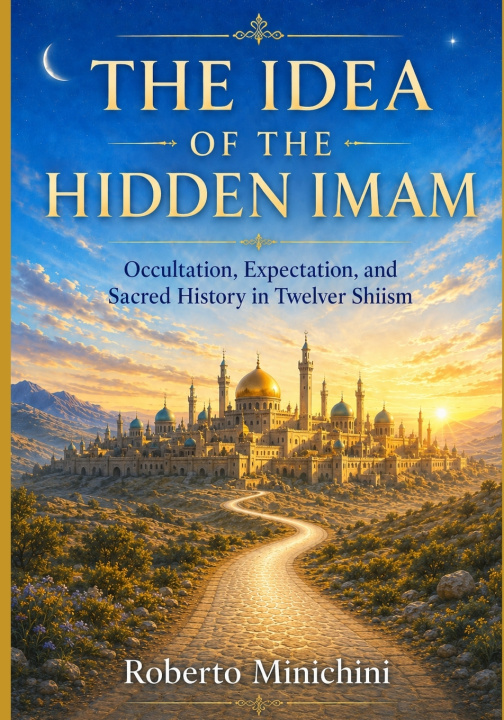
THE IDEA OF THE HIDDEN IMAM
Occultation, Expectation, and Sacred History in Twelver Shiism
 Englisch
 52 b
52 b
 Neu
Neu
Bis zu 30 Tage Rückgaberecht

This is a large-format volume, designed for readers who value substantial works of religious history, theology, and intellectual inquiry.
"THE IDEA OF THE HIDDEN IMAM"
"Occultation, Expectation, and Sacred History in Twelver Shiism"
For more than eleven centuries, Twelver Shiism has been shaped by one of the most remarkable doctrines in Islamic history: the belief that the twelfth Imam, Imam Muḥammad ibn al-Ḥasan al-Mahdī, remains alive in occultation and will return at the divinely appointed time. His physical absence did not bring sacred authority to an end. Instead, it created a religious condition that generated theology, jurisprudence, institutions, devotional practices, political theories, and forms of historical consciousness extending from the ninth century to the contemporary world.
This volume reconstructs that long development from its formative origins. It examines early Shiite ideas of Imamate and Mahdism, the succession crisis following the death of Imam al-Ḥasan al-ʿAskarī in 874, the formation of belief in the concealed twelfth Imam, the Minor Occultation and the four representatives, and the beginning of the Major Occultation in 941. Particular attention is given to the classical texts through which Twelver scholars defined the meaning of absence, continuity, divine guidance, and legitimate authority.
The study then follows the institutional consequences of occultation across the medieval and early modern periods. It explores the growing responsibilities of jurists, relations between scholars and temporal rulers, the Buyid, Seljuk, Mongol, and post-Mongol political environments, and the transformation brought by Safavid Iran, where Twelver Shiism became the religion of a major imperial state. The changing relationship between Shah, jurist, and Hidden Imam reveals how political power could acquire religious legitimacy without becoming identical with the sacred authority of the Imam.
The eighteenth and nineteenth centuries receive detailed treatment through the Akhbārī-Uṣūlī controversy, the consolidation of ijtihād and taqlīd, Shaykhism, the Bābī movement, the Tobacco Protest, and the Constitutional Revolution. The modern sections examine Najaf and Qom, the Pahlavi monarchy, the Iranian Revolution of 1979, Ayatollah Ruhollah Khomeini's theory of wilāyat al-faqīh, and alternative Twelver understandings of political authority. Particular care is taken to distinguish the Islamic Republic's institutional model from other Shiite positions that recognize extensive juristic authority without granting clerics direct sovereignty over the state.
The concluding discussion turns to contemporary religious life in Iran, Iraq, Lebanon, South Asia, the Gulf, and the global diaspora. Pilgrimage, prayers, Jamkarān, Arbaʿīn, devotional literature, narratives of encounters, digital communication, political symbolism, and the meaning of intiẓār-waiting for the Imam-are considered as modern expressions of a belief whose theological foundations remain rooted in the formative centuries of Twelver Islam.
Written as a historical and intellectual study rather than a polemical defense or rejection of belief, the book distinguishes respectfully between confessional teaching and historical-critical reconstruction. Its central concern is the extraordinary durability of a sacred authority whose concealment became, in itself, one of the organizing principles of Twelver religious history.
About the Author
Roberto Minichini is a writer, poet, essayist, astrologer, and independent researcher. Born in Mainz, Germany, in 1973 to an Italian father and a Croatian mother, he writes on philosophy, religion, mysticism, esotericism, intellectual history, literature, and the history of ideas. His interests include Islamic thought, Shiite spirituality, Sufism, comparative religion, traditional astrology, and the interaction between metaphysical traditions and historical change.


Informationen zum Buch
Englisch

Verschenken Sie dieses Buch noch heute
Es ist ganz einfach
1 Legen Sie das Buch in Ihren Warenkorb und wählen Sie den Versand als Geschenk 2 Wir schicken Ihnen umgehend einen Gutschein 3 Das Buch wird an die Adresse des beschenkten Empfängers geliefertHallo! Ich bin Libroamiko, dein Buchberater.
Wie kann ich dir helfen?