
 Kontakt
 Wie einkaufen
Versand
Kaufberater
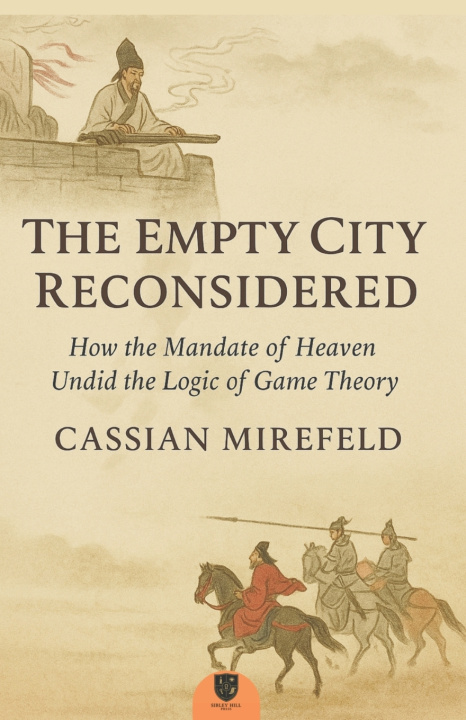
The Empty City Reconsidered
How the Mandate of Heaven Undid the Logic of Game Theory
 Englisch
 33 b
33 b
Bis zu 30 Tage Rückgaberecht

In an age that rewards cleverness and weaponizes perception, restraint is no longer recognized as command. The classical virtue of withholding, of refusing to strike when one could, has been recoded by modern strategy as error, naivety, or bluff.
The Empty City Reconsidered offers a civilizational correction.
Framed around Zhuge Liang's legendary act of stillness during the Three Kingdoms era, this manuscript challenges the modern reinterpretation of the "Empty City Stratagem" as mere psychological trickery. Against the logic of game theory, behavioral reductionism, and strategic cynicism, Cassian Mirefeld reconstructs the cosmological architecture that once governed the meaning of command: the Mandate of Heaven, Confucian virtue, Daoist non-action (wu wei), and the ritual ethics of power.
This is not military history. It is a reconstruction of cultural grammar, the moral frameworks through which civilizations once decided not merely how to win, but who was fit to rule.
Across four movements, the manuscript proceeds with precision:
Part I retells the original legend as it was preserved, without the distortions of modern psychological framing
Part II re-establishes the moral grammar of early imperial China: virtue as structural power, ritual as restraint, and legitimacy as cosmic condition
Part III presents cross-cultural mirrors, David's refusal to strike Saul, Moses' forfeiture of Canaan, Sun Tzu's model of conflictless victory, revealing a shared civilizational intuition about power, posture, and moral eligibility
Part IV critiques the modern erasure of these categories: how rational actor models replaced ethics with incentives, and how modernity rebranded manipulation as mastery
Mirefeld's voice joins a lineage of thinkers concerned with the deformation of virtue by systems:
Where Alasdair MacIntyre diagnosed the moral fragmentation of the West in After Virtue, Mirefeld examines its epistemological corollary in the East.
Where Yuri Pines and Mark Edward Lewis exposed the scaffolding of legitimacy in Chinese thought, Mirefeld reanimates its psychological and ritual force.
Where Foucault unveiled the machinery behind authority, this book remembers the ritual that once restrained it.
Where Tu Weiming and Roger Ames argued for a reverent re-entrance into Confucian cosmology, Mirefeld applies that entrance to a single tale, one that has been misread for centuries.
The result is not just a new interpretation of an old story, it is a reminder that there are still languages for restraint, legitimacy, and silence that do not collapse into performance.
The Empty City was never a trick. It was an invocation.
And in remembering that, we remember something about ourselves:
That power was never meant to be self-justifying.
That some victories, though possible, desecrate more than they secure.
That the right to command begins not with strength, but with stillness.


Informationen zum Buch
Englisch

Verschenken Sie dieses Buch noch heute
Es ist ganz einfach
1 Legen Sie das Buch in Ihren Warenkorb und wählen Sie den Versand als Geschenk 2 Wir schicken Ihnen umgehend einen Gutschein 3 Das Buch wird an die Adresse des beschenkten Empfängers geliefertHallo! Ich bin Libroamiko, dein Buchberater.
Wie kann ich dir helfen?