
 Kontakt
 Wie einkaufen
Versand
Kaufberater
 Englisch
 42 b
42 b
 Neu
Neu
Bis zu 30 Tage Rückgaberecht

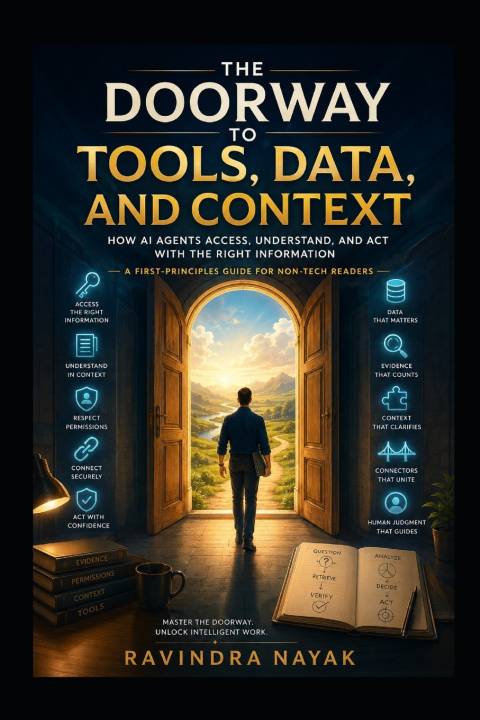
An AI agent can write a polished answer in seconds. But can it find the right file, use the right calculator, respect permissions, show its evidence, and stop before a risky action? That is the doorway between impressive language and dependable work.
The Doorway to Tools, Data, and Context is a calm, first-principles guide for non-technical readers who want to understand how AI agents reach calendars, documents, databases, search systems, business applications, and approved workplace tools-without receiving unlimited access.
Through the recurring story of The Common Ground Workshop, everyday analogies, natural dialogues, visual learning maps, original reflection passages, and practical exercises, Ravindra Nayak turns difficult ideas into an understandable journey. You will learn what tools, functions, applications, APIs, requests, responses, parameters, schemas, databases, resources, prompts, retrieval, authentication, authorization, connectors, and MCP actually mean-and why each boundary matters.
The mathematics arrives only after the intuition is secure. Data tables become readable. Coordinates and vectors become ways to describe closeness. Relevance scores become transparent ranking choices. Token limits, latency, and cost per tool call become practical design questions rather than frightening formulas.
This book also shows where systems fail: outdated documents, missing fields, conflicting evidence, excessive context, unsafe permissions, misleading tool descriptions, timeouts, duplicate actions, unknown completion, and blind retries. Each failure becomes a lesson in recovery, evidence, human approval, and responsible design.
At the center of the book is a complete no-code project: design a research assistant that retrieves information from approved sources, uses a calculator, records its evidence, works within clear budgets, and asks before taking external action.
Read this book if you want to:
• understand how AI agents use real tools and data;
• discuss APIs, schemas, retrieval, permissions, and MCP with confidence;
• judge whether an agent is genuinely useful or merely fluent;
• protect human authority while enabling practical assistance; and
• participate thoughtfully in an AI-enabled workplace without becoming a programmer.
You do not need a technical background. You need curiosity, a willingness to ask precise questions, and a belief that complex systems can be understood when they are built one clear layer at a time.


Informationen zum Buch
Englisch

Verschenken Sie dieses Buch noch heute
Es ist ganz einfach
1 Legen Sie das Buch in Ihren Warenkorb und wählen Sie den Versand als Geschenk 2 Wir schicken Ihnen umgehend einen Gutschein 3 Das Buch wird an die Adresse des beschenkten Empfängers geliefertHallo! Ich bin Libroamiko, dein Buchberater.
Wie kann ich dir helfen?