
Werden Sie Teil einer Gemeinschaft von Buchliebhabern aus der ganzen Welt und erhalten Sie eine Reihe von Vorteilen.
Konto kostenlos anlegen
DPD-Kurier 4.49 €
Hermes Kurierdienst 4.99 €
DHL-Kurier 3.99 €
Hermes-Stelle 4.49 €
DPD-Stelle 2.99 €
GLS-Kurierdienst 4.99 €
 Kontakt
 Wie einkaufen
Hilfe
Versand
DPD-Kurier 4.49 €
Hermes Kurierdienst 4.99 €
DHL-Kurier 3.99 €
Hermes-Stelle 4.49 €
DPD-Stelle 2.99 €
GLS-Kurierdienst 4.99 €
Kaufberater
Mein Konto
▸
Leer :-(
0
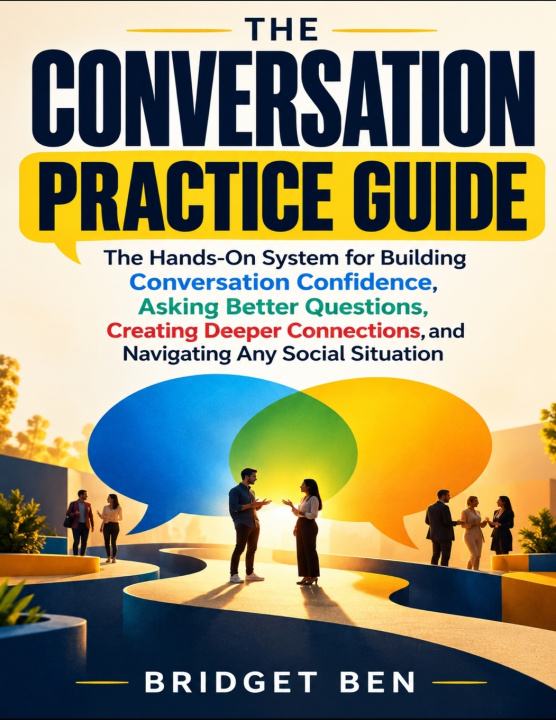
The Conversation Practice Guide
The Hands-On System For Building Conversation Confidence, Asking Better Questions, Creating Deeper Connections, And Navigating Any Social Situation
Sprache
 Englisch
Englisch
Buch
Broschur
What if becoming a better conversationalist had less to do with personality and more to do with prac...
Vollständige Beschreibung
Libristo-Code: 54071878
?
 57 b
57 b
 Demnächst
 Neu
Neu
57 b
Demnächst
Neu
23.09
€
inkl. MwSt.
Erwartete Einlagerung
Veröffentlichung 07. 10. 2026
Bis zu 30 Tage Rückgaberecht

What if becoming a better conversationalist had less to do with personality and more to do with practice?
The Conversation Practice Guide is a practical, hands-on system for developing stronger conversation skills through simple frameworks, exercises, reflection, and real-world practice. Whether you struggle to start conversations, run out of things to say, overthink your responses, or simply want to become a more engaging communicator, this guide gives you a structured path forward.
Inside, you'll learn how to:
- Start conversations naturally without relying on scripted lines
- Ask better questions that encourage meaningful responses
- Turn simple answers into deeper conversations
- Listen actively instead of planning your next response
- Use follow-up questions without making conversations feel like interviews
- Tell more engaging and organized stories
- Balance speaking and listening
- Navigate conversations when you have little in common
- Participate more comfortably in group conversations
- Make people feel heard, included, and valued
- Handle awkward pauses and conversational mistakes
- Recognize when a conversation is naturally ending
- Exit conversations gracefully
- Recover when an interaction does not go as planned
- Build confidence without pretending to be someone you are not
It is a practice guide designed to help you turn communication principles into usable skills. Throughout the book, you'll find practical exercises, reflection activities, conversation frameworks, practice prompts, visual tools, self-assessments, and worksheets that encourage you to apply what you learn.
The included 12-Week Conversation Transformation Plan provides a structured path for practicing your skills, reviewing your progress, and building greater consistency over time.
You don't have to become the loudest person in the room. You don't need to have something impressive to say every time. And you don't need to change your personality.
You can become a better conversationalist by learning how conversations work and deliberately practicing the skills that make them more natural, meaningful, and enjoyable.
Read it. Practice it. Reflect on it. Use it.
Because better conversations are not simply something you hope to have.
They are something you can learn to create.
Schauspielerin
&
Polyglotte
EWA KASP
für
Video abspielen


Libristo bietet die größte Auswahl an fremdsprachiger Literatur an. Deshalb kaufe ich meine Bücher hier ein.
Informationen zum Buch
Vollständiger Name
The Conversation Practice Guide
Autor
Bridget Ben
Sprache
Englisch
Englisch
Einband
Buch - Broschur
Datum der Veröffentlichung
2026
Anzahl der Seiten
138
EAN
9798178674635
Libristo-Code
54071878
Verlag
Independently published
Gewicht
339
Abmessungen
216 x 280 x 8

Verschenken Sie dieses Buch noch heute
Es ist ganz einfach
1 Legen Sie das Buch in Ihren Warenkorb und wählen Sie den Versand als Geschenk 2 Wir schicken Ihnen umgehend einen Gutschein 3 Das Buch wird an die Adresse des beschenkten Empfängers geliefert
Buchberater Libroamiko
Durch die Nutzung dieses Chats kommunizieren Sie mit generativer künstlicher Intelligenz. Mit der Nutzung erklären Sie sich auch mit der Verarbeitung personenbezogener Daten einverstanden.
Hallo! Ich bin Libroamiko, dein Buchberater.
Wie kann ich dir helfen?
Hallo, ich bin Libroamiko, kann ich helfen?