
 Kontakt
 Wie einkaufen
Versand
Kaufberater
 Englisch
 44 b
44 b
 Demnächst
 Neu
Neu
Bis zu 30 Tage Rückgaberecht

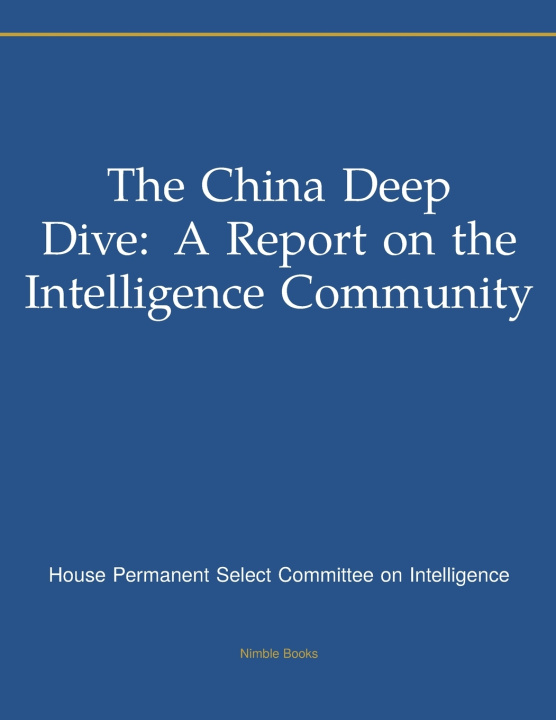
For nearly three decades after the Soviet collapse, American intelligence drifted, first through the complacency of the unipolar 1990s, then into the all-consuming counterterrorism mission that followed September 11. By 2019, while the spy agencies remained optimized for that earlier war, China had risen into a peer competitor. This report is the bipartisan congressional reckoning with that gap, and its verdict is unsparing.
The China Deep Dive: A Report on the Intelligence Community is the public, unclassified product of a two-year review by the House Permanent Select Committee on Intelligence (HPSCI), opened in May 2019. It arrived at one of the sharpest reorientations in national-security thinking since the Cold War, the pivot to great-power competition signaled by the 2017 National Security Strategy and the 2018 National Defense Strategy, and crystallized by Xi Jinping's consolidation of power, the militarization of the South China Sea, the "Made in China 2025" technology drive, the internment of Uyghurs, the crackdown in Hong Kong, and, mid-review, the emergence of COVID-19 in Wuhan amid Beijing's opacity and disinformation.
The inquiry was no desk exercise. Bipartisan staff conducted hundreds of hours of interviews, examined thousands of analytic assessments, and visited facilities operated by more than a dozen intelligence elements, organizing their findings around the six-phase intelligence cycle of planning, collection, processing, analysis, dissemination, and evaluation. The central conclusion was that the Intelligence Community had not sufficiently adapted to a world increasingly shaped by a rising China and by interlocking non-military transnational threats such as global health and economic security. Threaded through the findings were specific pathologies: a workforce thinned of deep China expertise and Mandarin proficiency; clearance policies that screened out the very people with the needed area knowledge; over-reliance on legacy counterterrorism systems and funding; a chronic underweighting of "soft" threats like pandemics; a failure to integrate open-source information; and excessive compartmentation. Most damning, the report concedes that the integration goals of the 2004 Intelligence Reform and Terrorism Prevention Act had never been achieved for targets unrelated to counterterrorism.
The review produced 23 public findings, 36 public recommendations, and more than 100 classified ones, the asymmetry itself revealing how much of the problem could not be discussed openly. The recommendations cluster into governance and authorities (a bicameral study group to reform the 1947 National Security Act and the 2004 reforms, a zero-based program review), people (mentorship for China analysts, reskilling of counterterrorism officers, expanded hiring of health professionals, economists, and technologists), an outward reorientation toward non-defense customers such as State, Treasury, and Commerce, and a warning baseline that explicitly includes indicators for a pandemic-potential disease.
This Nimble Books edition reproduces the public report faithfully and adds a full editorial apparatus prepared for this volume: a new Historical Context essay tracing the 2018-2020 strategic-competition pivot; two complementary abstracts, an accessible plain-language summary and an advanced analytical summary that separates the report's load-bearing allocative critique from its open-source scene-setting and weighs the consequences of its heavy redaction; a Glossary of intelligence terminology; Indexes of persons, places, and concepts; and an original computational "RKHS" knowledge-graph analysis situating it among related works on intelligence reform and U.S.-China competition. For scholars, policy analysts, intelligence professionals, students of government, and librarians, it preserves a prescient diagnostic of structural inertia at a hinge moment in American strategy.


Informationen zum Buch
Englisch

Verschenken Sie dieses Buch noch heute
Es ist ganz einfach
1 Legen Sie das Buch in Ihren Warenkorb und wählen Sie den Versand als Geschenk 2 Wir schicken Ihnen umgehend einen Gutschein 3 Das Buch wird an die Adresse des beschenkten Empfängers geliefertHallo! Ich bin Libroamiko, dein Buchberater.
Wie kann ich dir helfen?