
 Kontakt
 Wie einkaufen
Versand
Kaufberater
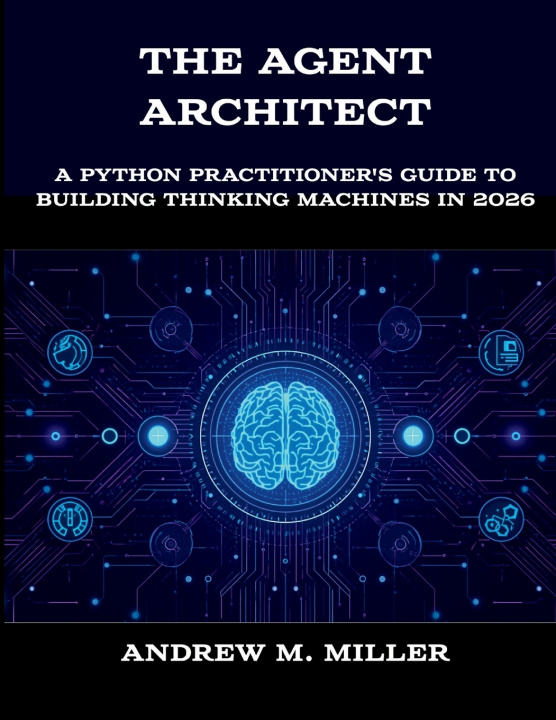
The Agent Architect
A Python Practitioner's Guide to Building Thinking Machines in 2026
 Englisch
 95 b
95 b
 Neu
Neu
Bis zu 30 Tage Rückgaberecht

What if software was no longer just a set of instructions... but something that could actually think through problems with you?
And more importantly, what if you could build it yourself using Python?
In The Agent Architect: A Python Practitioner's Guide to Building Thinking Machines in 2026 by Andrew M. Miller, you are invited into a very different way of designing systems-one where programs are no longer passive tools, but active decision-makers that plan, reason, adapt, and collaborate. But here is the real question: are you ready to move beyond traditional automation and step into systems that behave more like structured intelligence than static code?
Have you ever wondered why modern applications feel increasingly "intelligent," yet still unpredictable in how they respond to complex tasks? Or why some AI systems appear to reason, while others simply generate text without direction or memory? This book answers those questions by showing you how agent-based systems are actually constructed from the ground up.
But let's ask something deeper-what does it really mean for a machine to "think"?
Is it memory that makes it intelligent? Or the ability to plan ahead? Or is it how it evaluates its own mistakes and improves over time? Inside this guide, you'll explore each of these layers in practical, Python-based implementations that reveal how thinking systems are actually assembled.
You won't just read theory. You'll follow structured explanations of how agents:
break down long-term goals into manageable tasks
maintain memory across time and sessions
Have you ever built something that worked perfectly once, but failed the moment conditions changed? That's where agent architecture becomes essential. Instead of rigid workflows, you learn how to design systems that adapt dynamically to uncertainty, feedback, and evolving objectives.
This book challenges you to think differently about Python itself. It is no longer just a programming language for scripts or APIs. In this context, Python becomes the foundation for building cognitive structures-memory systems, reasoning engines, orchestration layers, and autonomous workflows.
Throughout the book, you will encounter architectures that show how modern agent systems are structured:
single-agent and multi-agent models
event-driven and goal-oriented systems
What happens when an agent can remember what it did yesterday? Or adjust its strategy based on failures from last week? Or coordinate with other agents to complete complex objectives?
But perhaps the most important question is this: what kind of systems are you building for the next decade of AI-driven software?
Because in 2026 and beyond, applications are not just responding to users-they are anticipating needs, planning actions, and executing multi-step workflows autonomously.
This book is designed for developers who are ready to work at that level of design thinking.
You will explore how to:
structure agents using clean Python architecture
manage memory systems that scale beyond context limits
So the real question becomes: are you still building applications-or are you ready to build agents that build decisions?
If you are a Python developer, engineer, researcher, or system designer looking to understand how modern autonomous systems are built in practice-not just in theory-this book gives you a structured path forward.
It does not assume intelligence. It shows you how to construct it.
If you are ready to move beyond traditional programming and start building systems that think, adapt, and act with purpose, this book is your starting point.
Take the next step. Build agents that don't just run code-build agents that reason through it.


Informationen zum Buch
Englisch

Verschenken Sie dieses Buch noch heute
Es ist ganz einfach
1 Legen Sie das Buch in Ihren Warenkorb und wählen Sie den Versand als Geschenk 2 Wir schicken Ihnen umgehend einen Gutschein 3 Das Buch wird an die Adresse des beschenkten Empfängers geliefertHallo! Ich bin Libroamiko, dein Buchberater.
Wie kann ich dir helfen?