
 Kontakt
 Wie einkaufen
Versand
Kaufberater
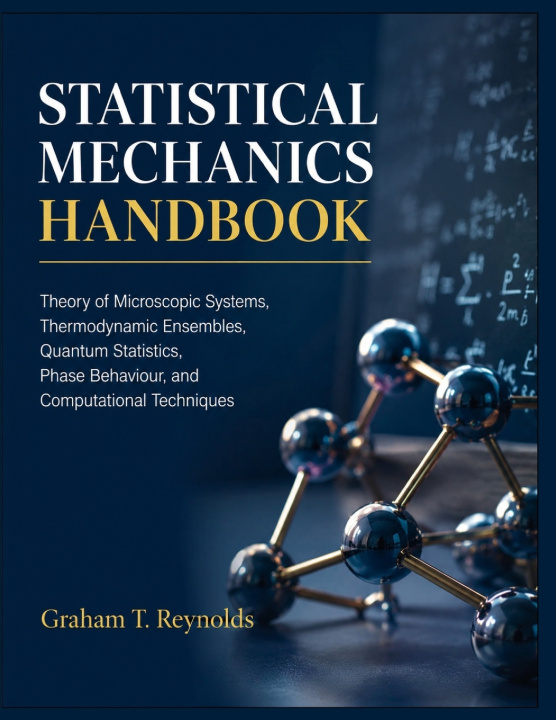
STATISTICAL MECHANICS HANDBOOK
Theory of Microscopic Systems, Thermodynamic Ensembles, Quantum Statistics, Phase Behaviour, and Computational Techniques
 Englisch
 169 b
169 b
 Neu
Neu
Bis zu 30 Tage Rückgaberecht

How do you go from microscopic states and probabilities to real thermodynamic predictions without getting lost in formulas you can use but cannot derive?
Statistical mechanics becomes difficult when probability, thermodynamics, mechanics, and quantum theory feel like separate subjects instead of parts of one framework. Memorized equations may get you through a familiar exercise, but they break down when the ensemble changes, interactions matter, a system approaches a phase transition, or a simulation produces a result you cannot explain. What you need is a way to see where the equations come from, what assumptions make them valid, and how to test whether the model fits the physical system.
STATISTICAL MECHANICS HANDBOOK gives you that structure. It develops the subject from microstates, probability, multiplicity, and entropy through classical and quantum ensembles, thermodynamics, interacting systems, phase behaviour, fluctuations, transport, stochastic dynamics, and simulation. Derivations are built from stated assumptions, variables and units are defined, and worked examples show the intermediate reasoning rather than hiding it behind final formulas.
After working through this handbook, you will be able to:
Calculate multiplicities, probabilities, entropies, ensemble averages, fluctuations, and response quantities from defined microscopic models.
Derive and apply microcanonical, canonical, and grand-canonical distributions and connect partition functions to thermodynamic potentials.
Evaluate ideal and interacting gases, molecular degrees of freedom, equations of state, virial behaviour, and interaction models.
Compare classical, Bose-Einstein, and Fermi-Dirac statistics and calculate occupation behaviour, quantum-gas properties, and crossover limits.
Analyse phase transitions, critical behaviour, order parameters, correlations, finite-size effects, and fluctuation-response relationships.
Estimate collision rates, mean free paths, diffusion, viscosity, and thermal conductivity while checking the assumptions behind kinetic models.
Apply master equations, random walks, Langevin and Fokker-Planck models, Monte Carlo methods, and molecular dynamics with convergence and uncertainty checks.
Key topics include state counting, entropy, phase space, thermodynamic ensembles, partition functions, chemical potential, quantum statistics, non-ideal systems, phase transitions, critical phenomena, correlations, kinetic theory, transport, nonequilibrium dynamics, stochastic processes, and computational simulation.
You will get the most from this handbook if you already understand calculus, introductory thermodynamics, classical mechanics, probability, and elementary quantum mechanics and want to connect them into a usable statistical framework. It is suited to advanced students, engineers, applied physicists, and technical readers who need both a teaching text and a reference. It does not replace professional judgment, laboratory safety procedures, institution-specific requirements, or verification of application-specific data and software results.
If you want to stop treating statistical mechanics as a collection of disconnected formulas and start seeing how microscopic assumptions produce macroscopic predictions, choose this handbook for the derivations, calculations, checks, and computational tools that make the subject usable.


Informationen zum Buch
Englisch
Kategorie
