
 Kontakt
 Wie einkaufen
Versand
Kaufberater
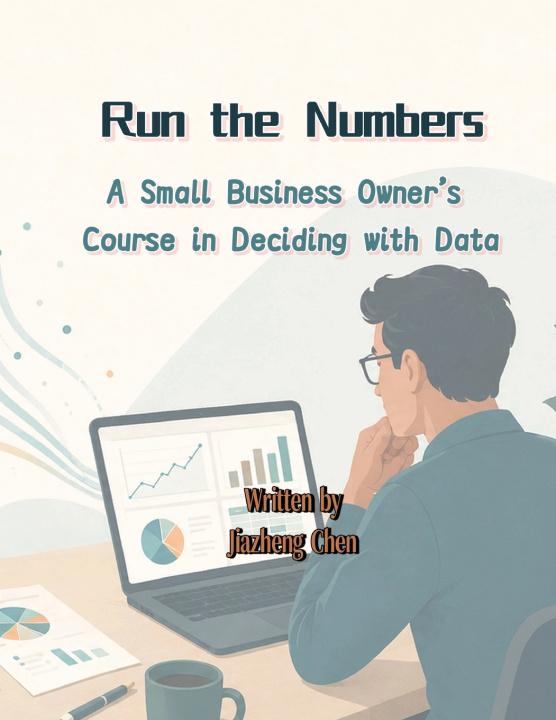
Run the Numbers
A Small Business Owner's Course in Deciding with Data
 Englisch
 114 b
114 b
 Neu
Neu
Bis zu 30 Tage Rückgaberecht

Who this book is for
You run a small business - an online store, a shop, or a supplier to other companies. Fewer than a dozen people, most days just you and two or three others. What actually reaches your pocket each year is somewhere between $50,000 and $200,000: not rich, but a living, and you'd like it to be better. You can build a spreadsheet, write a SUM, filter a column. But the moment someone says "model," "algorithm," or "data-driven," you tune out. You already have data - your storefront back end, your point of sale, your bank statements, your inventory sheet. You've just never used any of it to make a decision. You decide from experience, from feel, from a sense that it's probably about right. And you're right more than eight times out of ten. This book doesn't argue with that. It's written for the other two: the calls you were sure about that turned out to be expensive.
What it teaches
How to think with numbers - not how to operate software. Most books on this subject teach a tool, a function, a framework. You finish knowing how to click things, and you still don't know where to start on your own business. This one runs the other way. It begins with decisions you actually face - take this order or not, raise this price or not, hire this person or not, buy this much stock, kill this ad, open a second location - and works each one all the way through with a real company and real numbers.
Four fictional small businesses carry the whole book: a no-inventory outdoor-gear web store, an imported-snack shop that carries its own stock, a 24-car rental outfit, and a B2B ingredients distributor. They were chosen because their structures are opposites. One has almost no fixed costs; one is nearly all fixed cost. One has its money tied up in goods; the other has it tied up in customers. Put the same question to all four and the answers frequently contradict each other.
Which is the line the book most wants you to keep: the method travels, the numbers don't.
What it won't do
It won't save a business whose fundamentals don't work. It doesn't promise that following it guarantees anything. And it can't do the uncomfortable parts for you - letting someone go, renegotiating with a long-standing customer, admitting an investment is gone. Those calculations are easy. The arithmetic was never the hard part.
What you need
No code, no software purchase, no consultant. The mathematics never exceeds arithmetic, percentages, and ratios; one square root appears, and a spreadsheet function handles it. Every calculation in the book can be done by someone with a high school education and Excel.
54 chapters across 11 parts, 21 figures, and 5 appendices - including a practical guide to having AI build you a small management tool, the complete underlying data for all four companies, a metrics reference, an Excel reference, and a 313-entry glossary in plain language.
Set in the United States. Legal and tax material reflects 2026 conditions, with California used where state rules apply. All four companies and every figure are teaching illustrations. Nothing here is tax, legal, or investment advice.


Informationen zum Buch
Englisch

Verschenken Sie dieses Buch noch heute
Es ist ganz einfach
1 Legen Sie das Buch in Ihren Warenkorb und wählen Sie den Versand als Geschenk 2 Wir schicken Ihnen umgehend einen Gutschein 3 Das Buch wird an die Adresse des beschenkten Empfängers geliefertHallo! Ich bin Libroamiko, dein Buchberater.
Wie kann ich dir helfen?