
 Kontakt
 Wie einkaufen
Versand
Kaufberater
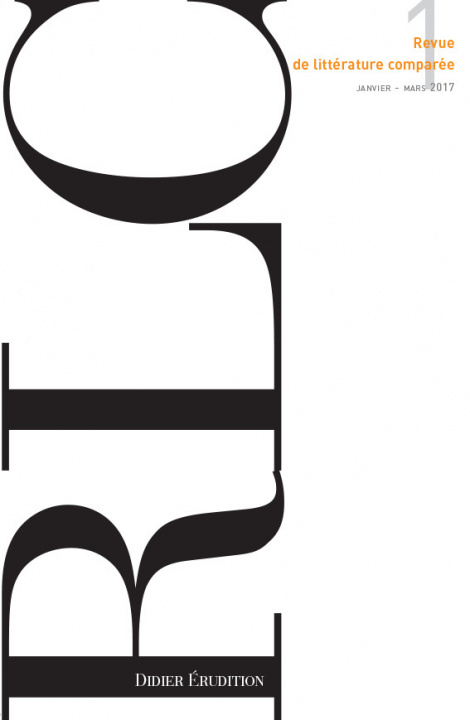
Revue de Litterature Comparee - No1/2017
 Französisch
 62 b
62 b
Bis zu 30 Tage Rückgaberecht
Kunden kauften auch
















 /
/
 Broschur
 15.30
€
15.30
€






 /
Broschur
17.39
€
/
Broschur
17.39
€



 /
Hardcover
51.39
€
/
Hardcover
51.39
€



Ignacio RAMOS GAY, The Cervantine Myth on the Second Empire Stage: Victorien Sardou's Don Quichotte (1864) (in French), RLC XCI, no. 1, jan.-march 2017, p. 5-20. The aim of this paper is to analyze Victorien Sardou’s stage adaptation of Cervantes’s classic, first performed at the Gymnase in Paris in June 25th 1864, under the title Don Quichotte. Pièce en trois actes et huit tableaux. I will first examine the rewriting of the original novel in the light of the structure of the vaudeville genre and, more specifically, of the well-made play [pièce bien faite], as consecrated by Sardou’s forerunner and master, Eugène Scribe. Secondly, I will argue that the play is the reflection of the perception of Spain shared by the Second French Empire’s bourgeoisie, as shown by the cultural stereotypes presented on the stage. As the play is determined by the aesthetics of Boulevard drama and mainly addressed to a bourgeois playgoer, I will conclude that Sardou’s play is less a transgeneric adaptation of the original novel than the result of the constrictions imposed by both the vaudeville genre and the theatrical topography that frame it, thus becoming an image of the Second Empire’s cultural products.Cécile ROUSSELET, Beneath the Branch of Sakura. The Reception of Haiku in Post-Soviet Russia (in French), RLC XCI, no. 1, jan.-march 2017, p. 21-36.The reception of haiku in post-soviet Russia generates a highly creative poetic production. These Russian texts inherit from an actualized modernism and a distanced intertextuality with its models—both Japanese haiku and its French and occidental interpretations from the early XXth century. Two specificities make these texts truly original. First, they are part of a culture of authenticity, a quest for an immutable "truth"—after decades of suffering from a totalitarian interpretation of freedom of speech. Then, they convey an utopic message that is based on an idyllic imaginary of Japan and is reinvested by defamiliarizing forms in order to convey proper post-soviet ambitions. Laurent BÉGHIN, The French Edition of the Journal Lettre Internationale (1984-1993) between Western and Central Europe (in French), RLC XCI, no. 1, jan.-march 2017, p. 37-50. Founded by Antonín Liehm, the Lettre internationale journal showed a remarkable curiosity for the cultures of Central Europe. The quarterly was influenced by the spirit of the times. Indeed the French mid-eighties were characterized by a renewed interest in this part of Europe. From the first to the last issue, the magazine published numerous articles by writers from Central Europe or Western experts skilled in this region. The various issues draw a decidedly positive image of the Central-European world. All this would have been impossible without the systematic use of translation and an extensive network of translators and mediators.Varja BALŽALORSKY ANTIĆ, The Flowers of Evil in Slovenia: a short overview of translations and influences (in French), RLC XCI, no. 1, jan.-march 2017, p. 51-64. The paper Flowers of Evil in Slovenia: a short overview of translations and influences deals with several aspects of the reception of Baudelaire’s book in Slovenian literary field. Different phases of the progressive discovery of Baudelaire by Slovenian readership are presented, addressing questions such as: which aspects of Fleurs du mal were first discovered by Slovenian readers and poets—the side of spleen or the side of ideal—; which elements of the hybridity of symbolism, decadence and naturalism of Baudelaire’s poetics shaped the idea that the Slovenian readership could gain from Slovenian translations; which of these elements first influenced the poetics of Slovenian poets and when; in what way the first complete translation of the book in 2004 contributed to the overall picture of Baudelaire? Finally, the conclusions drawn from a case study of four translations of Harmonie du soir in different periods of 20th century help us to shed light on some problems of translating the alexandrine in Slovenian accentual-syllabic verse system.Justyna GAMBERT, A personalist meditation in pictures : a few convergences between Levinas’ thinking and Dostoevsky’s work (in French), RLC XCI, no. 1, jan.-march 2017, p. 65-84. Our article attempts to highlight a few intertextual and philosophical similarities between Levinas’ personalist approach and Dostoevsky’s novels and journalistic work. We will then show how Dostoevsky’s critique of the idealist ontology that has dominated the western philosophy from Descartes to Hegel anticipates Levinas’ conclusions. We will then look into the existential progressions of the author’s protagonists in his last novels to show they are an exemplary embodiment of the values advocated by Levinas’ philosophy of the Other.


Informationen zum Buch
Französisch

Verschenken Sie dieses Buch noch heute
Es ist ganz einfach
1 Legen Sie das Buch in Ihren Warenkorb und wählen Sie den Versand als Geschenk 2 Wir schicken Ihnen umgehend einen Gutschein 3 Das Buch wird an die Adresse des beschenkten Empfängers geliefertDas könnte Sie auch interessieren

 /
Broschur
30.79
€
/
Broschur
30.79
€

Hallo! Ich bin Libroamiko, dein Buchberater.
Wie kann ich dir helfen?