
 Kontakt
 Wie einkaufen
Versand
Kaufberater
 Englisch
 59 b
59 b
 Demnächst
 Neu
Neu
Bis zu 30 Tage Rückgaberecht

What separates a delusion from religious faith? Evidence, or merely the number of people who believe it?
A man says that God speaks directly to him. He hears a divine voice, receives secret messages, and believes that supernatural forces control his life. If his claims fall outside an accepted religious tradition, psychiatry may examine them as possible symptoms of delusion. Yet when millions make equally unverifiable claims about voices, miracles, answered prayers, sacred objects, and divine intervention, society often calls those beliefs faith.
Why should popularity change the standard of truth?
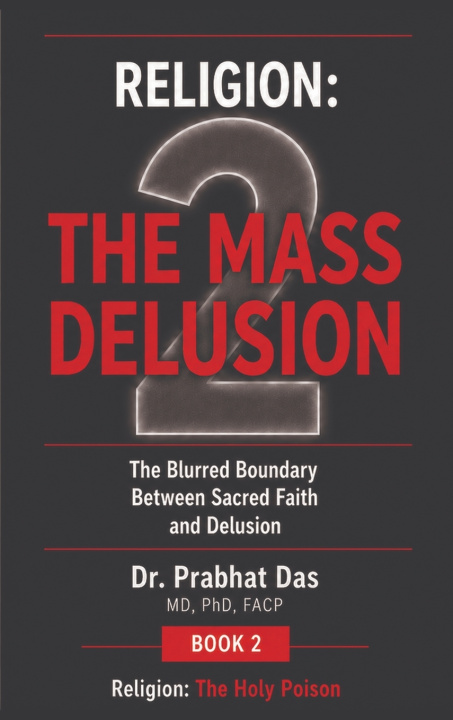
In Religion: The Mass Delusion: The Blurred Boundary Between Sacred Faith and Delusion, physician and author Dr. Prabhat Das confronts one of society's most protected double standards. Drawing on decades of medical experience, including more than ten years caring for patients in a large psychiatric hospital, he examines how the human mind can produce voices, visions, supernatural interpretations, and powerful feelings of certainty that seem completely real.
This book does not claim that every religious believer has a psychiatric disorder. Its argument is more precise, more disturbing, and much harder to dismiss: many religious beliefs have the same basic structure as delusions. They are held with deep conviction, lack independently verifiable evidence, resist contradictory facts, and depend heavily on revelation, scripture, tradition, or personal experience.
The crucial difference is often not evidence. It is cultural acceptance.
A supernatural belief expressed by one person may appear irrational. When the same belief is shared by millions, taught to children, repeated through ritual, defended by clergy, and protected by powerful institutions, it becomes familiar and respectable. But widespread acceptance cannot transform a false claim into truth. A belief does not become more rational simply because it has survived for centuries.
In this bold and persuasive book, Dr. Das explores:
- Why sincerity and absolute certainty do not prove that a belief is true
- How voices, visions, miracles, and divine messages can feel completely real
- How children inherit religious beliefs before they are old enough to question them
- Why repetition, ritual, fear, hope, and group approval strengthen unsupported claims
- How religious institutions protect sacred beliefs from ordinary examination
- Why psychiatry treats culturally approved beliefs differently from similar private beliefs
- How society confuses tradition with truth, popularity with proof, and comfort with reality
Dr. Das directly challenges readers, society, and the psychiatric community to reconsider religion's protected status. If a belief would be considered delusional when held by one person, should it become rational when shared by millions? Does culture reveal the truth, or merely decide which unsupported beliefs are permitted?
Religion: The Mass Delusion presents Dr. Das's firm belief that humanity will gradually move toward science, reason, evidence-based atheism, and secular humanism. In that more rational future, supernatural beliefs may no longer receive an automatic exemption from the standards applied to every other claim about reality. Religion may finally be recognized as a vast, inherited, culturally protected mass delusion.
This is the second book in Religion: The Holy Poison, Dr. Prabhat Das's provocative series examining how religion damages reason, freedom, equality, childhood, politics, peace, and human dignity.
Do not accept this book's conclusion blindly. Examine the evidence. Compare the beliefs. Question the double standard. Then decide for yourself where sacred faith ends and delusion begins.


Informationen zum Buch
Englisch

Verschenken Sie dieses Buch noch heute
Es ist ganz einfach
1 Legen Sie das Buch in Ihren Warenkorb und wählen Sie den Versand als Geschenk 2 Wir schicken Ihnen umgehend einen Gutschein 3 Das Buch wird an die Adresse des beschenkten Empfängers geliefertHallo! Ich bin Libroamiko, dein Buchberater.
Wie kann ich dir helfen?