
 Kontakt
 Wie einkaufen
Versand
Kaufberater
Radio Electronics for Amateur Radio Operators
Volume 3: RF Systems and Signal Processing
 Englisch
 81 b
81 b
 Neu
Neu
Bis zu 30 Tage Rückgaberecht

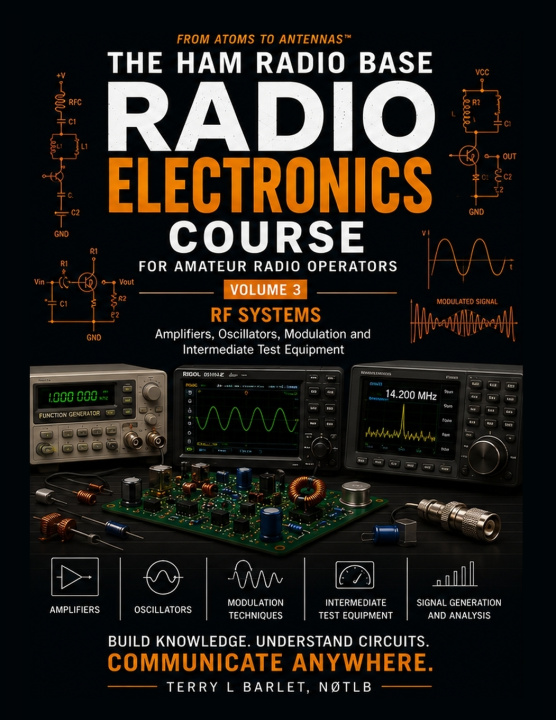
Volume 3: RF Systems and Signal Processing takes readers beyond basic circuit theory and into the electronic systems that make modern amateur radio communication possible. Building on the electrical principles, analog circuits, and measurement techniques introduced in the previous volumes, this book explores how radio-frequency signals are generated, amplified, processed, transmitted, received, and measured in practical communication systems.
Beginning with the fundamentals of RF signal generation, readers learn how oscillators produce stable frequencies and how buffers, amplifiers, and frequency multipliers prepare signals for transmission. The book explains modulation techniques including AM, FM, SSB, CW, and digital methods, showing how information is placed onto radio-frequency carriers and recovered by receivers. Readers gain a practical understanding of mixers, intermediate frequency stages, local oscillators, frequency conversion, filtering, automatic gain control, detection, and audio recovery.
Detailed coverage of RF amplifiers examines Class A, AB, B, and C operation, gain, efficiency, linearity, distortion, impedance matching, and stability. Practical chapters explain low-noise amplifiers, driver stages, final power amplifiers, harmonic suppression, and the importance of maintaining clean transmitted signals that meet regulatory requirements.
Receiver design is explored from the antenna input through the speaker, introducing superheterodyne architecture, direct conversion, image rejection, selectivity, sensitivity, dynamic range, noise figure, and signal-to-noise ratio. Readers learn how modern receivers separate weak signals from noise while maintaining excellent frequency stability and audio quality.
The book also examines filters, resonant circuits, crystals, ceramic resonators, frequency synthesis, phase-locked loops, mixers, balanced modulators, directional couplers, attenuators, splitters, combiners, and other building blocks found throughout amateur radio equipment. Each topic is presented with clear illustrations, circuit diagrams, and practical examples that connect theoretical concepts with real-world radio systems.
A dedicated section focuses on RF measurement techniques and intermediate-level test equipment, including oscilloscopes, frequency counters, signal generators, spectrum analyzers, RF power meters, modulation monitors, dummy loads, antenna analyzers, and vector network analyzers. Readers learn proper measurement techniques, calibration procedures, troubleshooting strategies, and methods for safely evaluating transmitters, receivers, and RF components.
Throughout the book, mathematical concepts are introduced gradually with worked examples that demonstrate how engineering calculations relate directly to practical circuit performance. Readers develop confidence in interpreting schematics, following signal flow, analyzing system performance, identifying faults, and understanding why each stage of a communication system operates as it does.
Designed specifically for amateur radio operators, electronics students, experimenters, and homebrewers, Volume 3 bridges the gap between electronic circuits and complete communication systems. Whether constructing transmitters and receivers, restoring vintage equipment, experimenting with RF design, preparing for advanced amateur radio projects, or expanding technical knowledge, readers gain the practical understanding needed to work confidently with radio-frequency electronics.


Informationen zum Buch
Englisch
Kategorie

Verschenken Sie dieses Buch noch heute
Es ist ganz einfach
1 Legen Sie das Buch in Ihren Warenkorb und wählen Sie den Versand als Geschenk 2 Wir schicken Ihnen umgehend einen Gutschein 3 Das Buch wird an die Adresse des beschenkten Empfängers geliefertHallo! Ich bin Libroamiko, dein Buchberater.
Wie kann ich dir helfen?