
 Kontakt
 Wie einkaufen
Versand
Kaufberater
Photonic Intelligence
 Englisch
 74 b
74 b
 Demnächst
 Neu
Neu
Bis zu 30 Tage Rückgaberecht

ABOUT THE BOOK
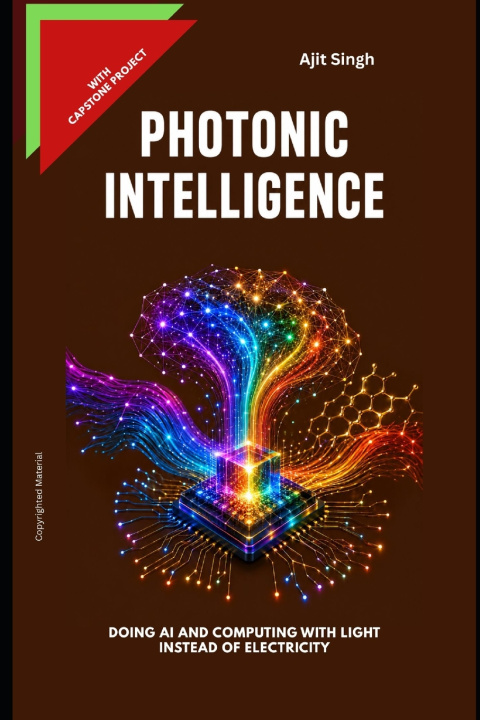
Photonic Intelligence is an exhaustive, highly practical manual designed to bridge the critical gap between traditional artificial intelligence software development and next-generation optical hardware. As the tech industry faces the physical limitations of silicon-based microprocessors, the demand for high-speed, low-power computing alternatives has skyrocketed. This book delivers a comprehensive, end-to-end blueprint for developing AI applications powered by light.
Philosophy
The core philosophy of this book is strictly centered on practical application and real-world implementation. For too long, the subject of optical computing has been confined to academic research papers, buried under heavy theoretical physics and complex mathematical proofs. This book strips away the unnecessary theory. The guiding principle here is "Learning by Building." If a concept cannot be translated into a usable, deployable application, it is minimized. I focused on the "How-To"-how to design the architecture, how to write the software, how to interface with the photonic chip, and how to deploy the final solution into a production environment.
Key Features
1. End-to-End Lifecycle Coverage: Covers everything from scratch (concept and design) to build, setup, deployment, implementation, and final production.
2. Industry-Relevant Curriculum: Aligned entirely with current and upcoming enterprise demands. Focuses on speed, latency reduction, energy efficiency, and high-performance computing.
3. Hardware and Software Co-Design: Explains the intricate middleware and framework services required to make Python-based AI models communicate with laser-driven optical chips.
4. Comprehensive Chapter Structuring: Every chapter is meticulously organized to include design, model, architecture, framework, services, components, implementation, deployment, functioning, future scope, applications, and mode of operations wherever applicable.
5. Live DIY Capstone Project: The final chapter is a complete, working application. It provides the exact code, line-by-line explanations, and setup instructions to build a Photonic Object Recognition App.
Key Takeaways
Upon completing this book, the reader will possess the following actionable skills and knowledge:
1. The ability to clearly define, classify, and explain the need for Photonic Intelligence compared to traditional silicon successors.
2. Practical skills to design and model AI architectures specifically optimized for optical execution.
3. The capability to set up the necessary hardware environments and configure middleware frameworks for photonic processing.
4. The expertise to write, implement, and deploy optical algorithms using simple, step-by-step logic.
5. Mastery over the integration of optical edge devices and cloud-based photonic servers.
6. The competence to deploy and manage applications in a live production environment, utilizing real-world scaling and maintenance strategies.
7. A fully developed, completely coded, and working DIY Capstone Application (Photonic Object Recognition) ready for portfolio presentation or enterprise adaptation.
Disclaimer: Earnest request from the Author.
Kindly go through the table of contents and refer kindle edition for a glance on the related contents.
Thank you for your kind consideration!


Informationen zum Buch
Englisch
