
 Kontakt
 Wie einkaufen
Versand
Kaufberater
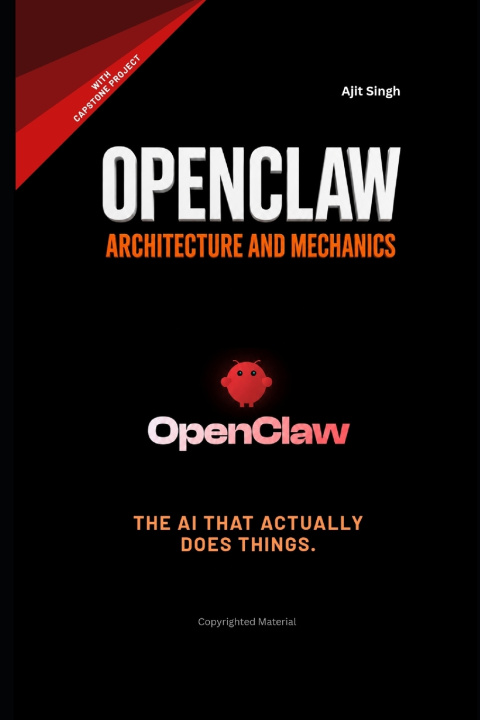
OpenClaw Architecture and Mechanics
 Englisch
 56 b
56 b
 Neu
Neu
Bis zu 30 Tage Rückgaberecht

"OpenClaw Architecture and Mechanics" is an exhaustive, practical, and highly detailed technical manual designed to take readers from absolute zero to the successful deployment of a fully functional, industry-grade automated mechanical system. This section breaks down the core elements that define this book's structure, purpose, and value.
Philosophy
The driving philosophy behind this book is "Implementation Over Abstraction." In the modern tech and manufacturing sectors, knowing about a technology is useless unless you know how to build and deploy it. The industry suffers from a surplus of theorists and a deficit of builders. This book is engineered to create builders. I believe that mechanical design and software architecture cannot be taught in isolation. They are two halves of the same system.
Key Features
1. End-to-End Coverage: This is not just a hardware book, nor just a software book. It covers design, 3D modeling, architecture, backend frameworks, microservices, component integration, physical implementation, and final deployment.
2. Production-Ready Focus: We do not stop at a working prototype. Chapters are dedicated to CI/CD pipelines, scaling, deployment, and live production environments.
3. Modular Architecture: The OpenClaw framework taught here is highly modular. You will learn how to design components and services that can be swapped, upgraded, and maintained without tearing down the entire system.
4. Live DIY Capstone Project: The final chapter is a complete, working capstone project that incorporates every concept learned in the previous nine chapters, complete with full, annotated source code.
Key Takeaways
By the time you finish this book, you will possess the ability to:
1. Comprehend the complete history, evolution, and foundational mechanics of modern robotic gripper architectures.
2. Design and assemble the physical components of the OpenClaw system from scratch.
3. Architect a robust, scalable software framework that acts as the brain of the mechanical system.
4. Implement simple, highly effective algorithms to control physical hardware using basic numbered-list logic.
5. Develop, test, and debug control applications that interface seamlessly with hardware sensors and actuators.
6. Deploy your developed solutions into live, production-grade environments using industry-standard tools and practices.
7. Understand the future scope of automation and how to adapt your designs for upcoming technological shifts.
8. Possess a fully functional, live DIY capstone project that proves your capability to design, build, and deploy an integrated hardware-software solution.
Disclaimer: Earnest request from the Author.
Kindly go through the table of contents and refer kindle edition for a glance on the related contents.
Thank you for your kind consideration!


Informationen zum Buch
Englisch
Kategorie

Verschenken Sie dieses Buch noch heute
Es ist ganz einfach
1 Legen Sie das Buch in Ihren Warenkorb und wählen Sie den Versand als Geschenk 2 Wir schicken Ihnen umgehend einen Gutschein 3 Das Buch wird an die Adresse des beschenkten Empfängers geliefertHallo! Ich bin Libroamiko, dein Buchberater.
Wie kann ich dir helfen?