Werden Sie Teil einer Gemeinschaft von Buchliebhabern aus der ganzen Welt und erhalten Sie eine Reihe von Vorteilen.
Konto kostenlos anlegen
DPD-Kurier 4.49 €
Hermes Kurierdienst 4.99 €
DHL-Kurier 3.99 €
Hermes-Stelle 4.49 €
DPD-Stelle 2.99 €
GLS-Kurierdienst 4.99 €
 Kontakt
 Wie einkaufen
Hilfe
Versand
DPD-Kurier 4.49 €
Hermes Kurierdienst 4.99 €
DHL-Kurier 3.99 €
Hermes-Stelle 4.49 €
DPD-Stelle 2.99 €
GLS-Kurierdienst 4.99 €
Kaufberater
Mein Konto
▸
Leer :-(
0
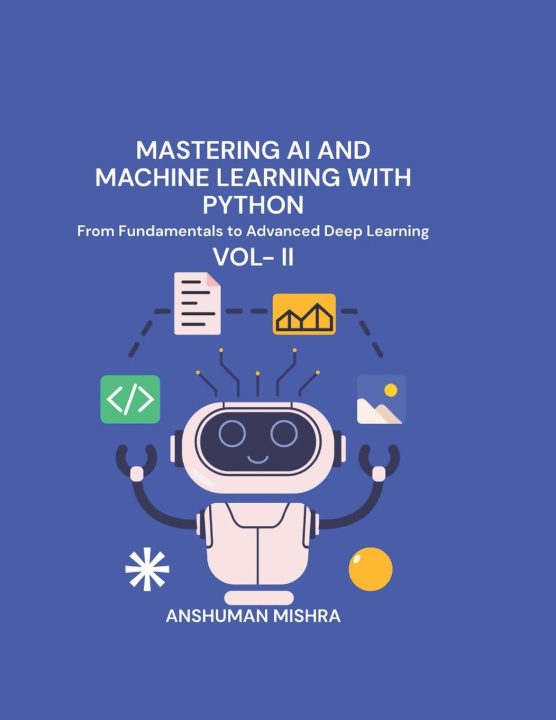
Mastering AI and Machine Learning with Python
From Fundamentals to Advanced Deep Learning Vol- II
Sprache
 Englisch
Englisch
Buch
Broschur
Chapter 9: Convolutional Neural Networks (CNNs)This chapter likely begins by revisiting the fundamen...
Vollständige Beschreibung
Libristo-Code: 51162552
?
 38 b
38 b
38 b
15.39
€
inkl. MwSt.
Externes Lager
Wir versenden in 14-21 Tagen
Bis zu 30 Tage Rückgaberecht
Kunden kauften auch



 /
/
 Broschur
 13.99
€
13.99
€

Chapter 9: Convolutional Neural Networks (CNNs)
This chapter likely begins by revisiting the fundamental concepts of convolutional operations. It would meticulously explain how convolution works, including the roles of filters (kernels), strides, padding, and activation functions in extracting meaningful features from image data. The concept of feature maps, which represent the output of applying filters at different layers, would be thoroughly discussed, emphasizing how these maps capture hierarchical representations of visual information.
The chapter would then transition into exploring various influential CNN architectures.
- LeNet: This pioneering CNN architecture, designed for handwritten digit recognition, would be presented as a foundational example, illustrating the basic building blocks of a CNN. Its layers, including convolutional layers, pooling layers (like average pooling), and fully connected layers, would be explained in detail. The historical significance of LeNet in the development of modern CNNs would also likely be highlighted.
- AlexNet: This groundbreaking architecture, which achieved remarkable success in the ImageNet Large Scale Visual Recognition Challenge (ILSVRC), would be analyzed for its key innovations. These include the use of ReLU activation functions, dropout for regularization, and the utilization of multiple GPUs for training. The impact of AlexNet on the field of computer vision and the resurgence of deep learning would be emphasized.
- VGG (Visual Geometry Group): The chapter would delve into the VGG networks, known for their deep and uniform architectures consisting of small convolutional filters stacked together. The concepts of VGG16 and VGG19, along with their consistent use of 3×3 convolutional kernels, would be explained. The advantages and limitations of VGG networks, such as their depth and large number of parameters, would likely be discussed.
- ResNet (Residual Network): This architecture, which addressed the vanishing gradient problem in very deep networks through the introduction of residual connections (skip connections), would be thoroughly examined. The concept of identity mappings and how they facilitate the training of extremely deep networks would be explained. Different ResNet variants (e.g., ResNet-50, ResNet-101) and their performance benefits would likely be covered.
- Image Classification: This fundamental task of assigning a label to an entire image based on its content would be discussed. Different loss functions (e.g., cross-entropy) and evaluation metrics (e.g., accuracy, F1-score) used in image classification would be explained.
- Object Detection: This more complex task of identifying and localizing multiple objects within an image using bounding boxes would be introduced. Early object detection architectures and the fundamental challenges involved would likely be discussed, setting the stage for more advanced techniques covered in later chapters.
This chapter would shift focus to sequential data and how Recurrent Neural Networks (RNNs) are designed to process it. The fundamental concept of how RNNs maintain an internal state (memory) to handle sequences would be explained, along with the challenges associated with training vanilla RNNs, such as the vanishing and exploding gradient problems.
Schauspielerin
&
Polyglotte
EWA KASP
für
Video abspielen


Libristo bietet die größte Auswahl an fremdsprachiger Literatur an. Deshalb kaufe ich meine Bücher hier ein.
Informationen zum Buch
Vollständiger Name
Mastering AI and Machine Learning with Python
Autor
Anshuman Mishra
Sprache
Englisch
Englisch
Einband
Buch - Broschur
Datum der Veröffentlichung
2025
Anzahl der Seiten
272
EAN
9798283669786
Libristo-Code
51162552
Verlag
Independently published
Gewicht
639
Abmessungen
216 x 280 x 15

Verschenken Sie dieses Buch noch heute
Es ist ganz einfach
1 Legen Sie das Buch in Ihren Warenkorb und wählen Sie den Versand als Geschenk 2 Wir schicken Ihnen umgehend einen Gutschein 3 Das Buch wird an die Adresse des beschenkten Empfängers geliefertDas könnte Sie auch interessieren




 /
Broschur
15.39
€
/
Broschur
15.39
€
 /
Broschur
39.49
€
/
Broschur
39.49
€