
 Kontakt
 Wie einkaufen

Versand
Kaufberater
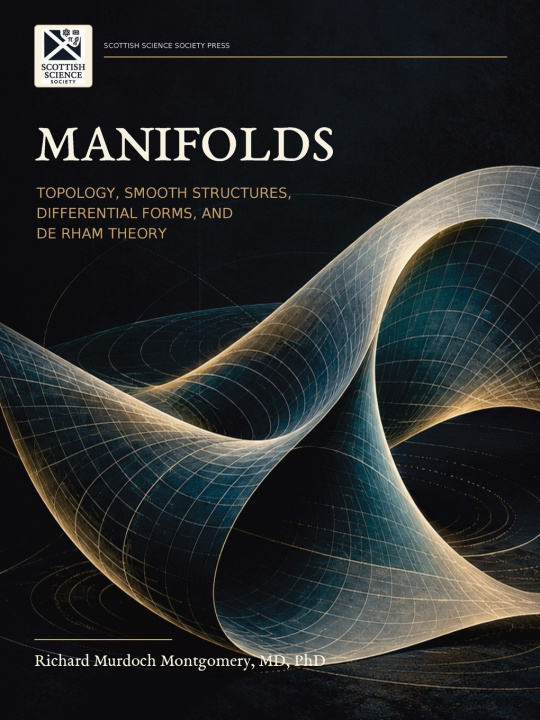
Manifolds
Topology, Smooth Structures, Differential Forms, and de Rham Theory
 Englisch
 85 b
 Demnächst
 Neu
Bis zu 30 Tage Rückgaberecht

Books ought to say at the door why they have come. This one has come to teach the
theory of manifolds from the point at which coordinates cease to be global through the
point at which differential forms begin to detect topology. It is written for the student who
has learned multivariable calculus and linear algebra and wants to see, rather than
merely invoke, the machinery by which calculus is transported onto curved spaces.
The method is deliberately cumulative. Topological manifolds are built before smooth
ones; smooth maps before tangent vectors; tangent and cotangent geometry before vector
fields; vector fields before differential forms; forms before integration; and integration
before de Rham cohomology. Results needed before their proofs are identified as loans
and repaid later. Objections are treated as part of the argument rather than as
interruptions to it.
The book therefore ends where a first graduate course can end with intellectual
completeness: at de Rham cohomology. By that point the reader has seen local
coordinates become an invariant calculus and has seen that calculus discover global
information which no single chart contains.
Every chapter begins with a section-by-section presentation page. The detailed Contents
below gives the larger map; the chapter leaves give the local map.A manifold is locally simple and globally capable of structure that no coordinate system
can display at once. The first problem is to make 'locally Euclidean' precise without
smuggling in an ambient Euclidean space. The second is to decide when overlapping
coordinate systems agree well enough for differentiation. The third is to determine which
constructions survive the change of coordinates.
The twelve chapters follow one continuous argument: topological foundations lead to
smooth structures and smooth maps; submanifolds and quotients show how new
manifolds are cut out and glued together; tangent and cotangent spaces turn
differentiation into intrinsic linear algebra; vector fields and flows introduce dynamics;
differential forms make integration coordinate-free; Stokes' theorem unifies the classical
integral theorems; and de Rham cohomology shows that differential calculus can count
holes.
The endpoint is not merely a stopping place. It is the first point at which the
local-to-global programme has produced an invariant with genuinely topological force:
closed forms need not be exact, their failure to be exact is measured by cohomology, and
the resulting classes support degree, obstruction and linking arguments. The book closes
there by design, as a complete treatment of this stage of manifold theory.


Informationen zum Buch
Englisch

Verschenken Sie dieses Buch noch heute
Es ist ganz einfach
1 Legen Sie das Buch in Ihren Warenkorb und wählen Sie den Versand als Geschenk 2 Wir schicken Ihnen umgehend einen Gutschein 3 Das Buch wird an die Adresse des beschenkten Empfängers geliefertHallo! Ich bin Libroamiko, dein Buchberater.
Wie kann ich dir helfen?