
 Kontakt
 Wie einkaufen
Versand
Kaufberater
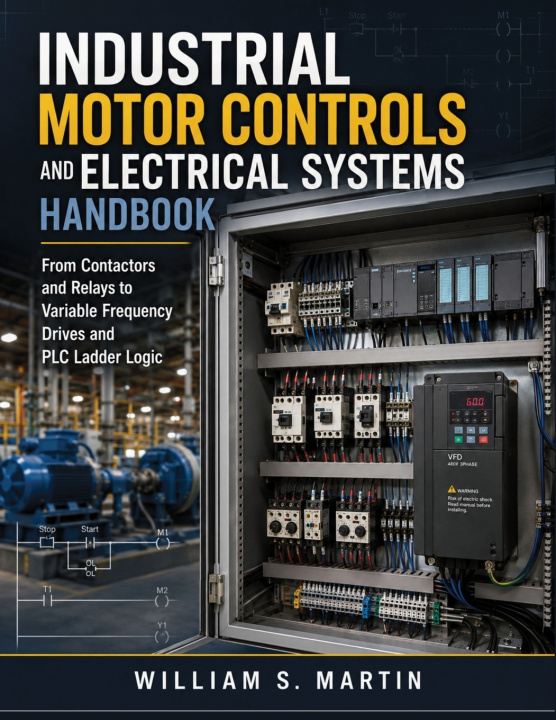
Industrial Motor Controls and Electrical Systems Handbook
From Contactors and Relays to Variable Frequency Drives and PLC Ladder Logic
 Englisch
 145 b
145 b
 Neu
Neu
Bis zu 30 Tage Rückgaberecht

A motor that ran perfectly on Friday can refuse to start on Monday - and the wiring diagram taped inside the panel no longer matches the machine in front of you. Somewhere between the service entrance and the shaft, one decision went wrong: a conductor undersized, a starter misapplied, an overload set from the wrong number, a drive parameter left at default. Finding it means understanding the whole chain, not just one link.
For most people who work on industrial machinery, that knowledge arrives in scattered pieces - clean theory in the classroom, disconnected rules of thumb on the plant floor, and the two rarely meet. This handbook was written to bring them together. It develops every idea from first principles and carries it through to something you can use: a calculation you can perform, a circuit you can wire, a protective device you can size, and a fault you can trace - across the full path from contactors and relays to variable frequency drives and ladder logic.
Inside, you will learn to:
- Read a motor nameplate and select and size a motor for its load and environment.
- Size motor-circuit conductors and overload, short-circuit, and ground-fault protection, and coordinate them so the nearest device clears a fault first.
- Read, build, and modify ladder-diagram control - start-stop, seal-in, reversing, jogging, sequencing, and interlocking.
- Choose and apply the right starting method for a given motor and supply.
- Understand, set up, and commission a variable frequency drive, and recognize its effects on the motor and the line.
- Program and read programmable-controller ladder logic, including timers, counters, and the scan cycle.
- Troubleshoot motors, control circuits, and drives with a systematic method and the right instrument.
It is written for apprentice and working electricians, maintenance and controls technicians, practicing engineers, and upper-level students - anyone who installs, wires, protects, commissions, or maintains industrial motor circuits.
Add this comprehensive, practical handbook to your bench and start building an end-to-end command of industrial motor control that holds up when the machine no longer matches the drawing.


Informationen zum Buch
Englisch

Verschenken Sie dieses Buch noch heute
Es ist ganz einfach
1 Legen Sie das Buch in Ihren Warenkorb und wählen Sie den Versand als Geschenk 2 Wir schicken Ihnen umgehend einen Gutschein 3 Das Buch wird an die Adresse des beschenkten Empfängers geliefertHallo! Ich bin Libroamiko, dein Buchberater.
Wie kann ich dir helfen?