
 Kontakt
 Wie einkaufen
Versand
Kaufberater
 Englisch
 70 b
70 b
 Neu
Neu
Bis zu 30 Tage Rückgaberecht

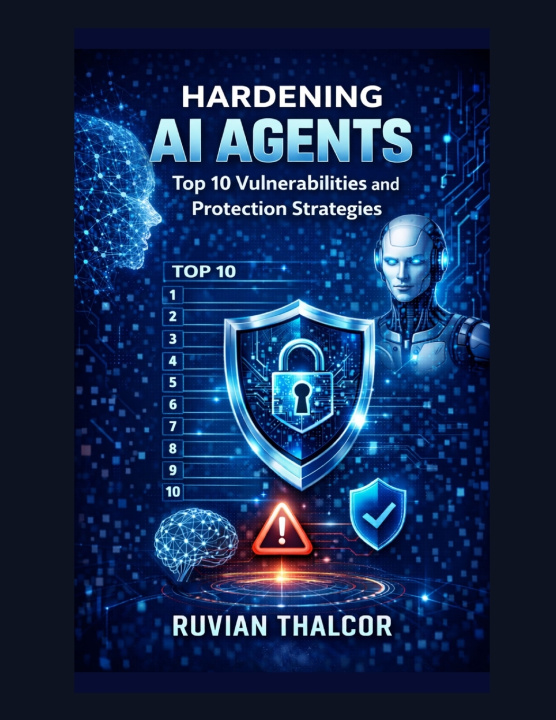
AI agents are no longer just answering questions. They plan. They decide. They act. And sometimes, they act in ways that make security teams deeply uncomfortable.
Hardening AI Agents is a practical, opinionated, and field-tested guide to securing autonomous AI systems that operate across tools, memory, and time. If traditional application security feels insufficient when dealing with AI agents, that is because it is.
This book introduces the top ten vulnerability categories for AI agents - mapped directly to real-world agent architectures and labeled AIA01 through AIA10. Each category is explored with practical examples, attacker perspectives, defensive strategies, hands-on labs, and implementation-ready checklists your team can deploy immediately.
Inside, every major agent vulnerability category gets a full, practical treatment:
AIA01 - Prompt Injection in Agent Workflows - how attackers hijack agent instructions across multi-step tasks and why single-turn defenses are not enough
AIA02 - Memory Poisoning - how corrupted long-term memory shapes future agent behavior in ways that are invisible until it is too late
AIA03 - Tool and Function Abuse - how agents are manipulated into calling the wrong tools, with the wrong inputs, at the wrong time
AIA04 - Excessive Autonomy - what happens when agents accumulate permissions and capabilities beyond what any single task requires
AIA05 - Insecure Execution Environments - how sandboxing failures, code execution risks, and environment misconfigurations create catastrophic blast radius
AIA06 - Identity and Access Control Failures - why agents need their own identity, privilege boundaries, and least-privilege enforcement - not inherited user credentials
AIA07 - Agent-Driven Denial of Service - how autonomous loops, retry storms, and resource exhaustion attacks emerge from agent behavior itself
AIA08 - Overreliance on Automated Decisions - how excessive trust in agent output creates organizational risk that no technical control alone can fix
AIA09 - Monitoring and Detection Gaps - why traditional logging and alerting fail in agent environments and how to build observability that actually works
AIA10 - Supply Chain Risks in Agent Ecosystems - third-party tools, plugins, models, and data sources as attack vectors unique to autonomous agent architectures
Every chapter is grounded in production realities with realistic attack scenarios, defensive design patterns, and checklists that work under real engineering constraints. The tone is intentionally human, occasionally humorous, and relentlessly practical - because nobody secures systems well when the guidance reads like a compliance document.
Hardening AI Agents is Book 6 in the series:
The AI Security & Hacking Bible: Protect and Exploit LLMs and Autonomous Agents
Earlier titles - LLM Security in Practice, AI Threat Modeling, The LLM Top 10 Security Guide, and Red Teaming LLMs - lay the groundwork for understanding model-level risks. How AI Agents Work builds the agent internals foundation this book depends on. The AI Agent Attacker's Playbook takes the offensive perspective on everything hardened here. Later volumes - Building Bulletproof AI, AI Security Operations Guide, and 10 Real AI Security Incidents - expand these defenses into architecture, operations, and post-incident learning. This book is where defensive discipline begins.


Informationen zum Buch
Englisch

Verschenken Sie dieses Buch noch heute
Es ist ganz einfach
1 Legen Sie das Buch in Ihren Warenkorb und wählen Sie den Versand als Geschenk 2 Wir schicken Ihnen umgehend einen Gutschein 3 Das Buch wird an die Adresse des beschenkten Empfängers geliefertHallo! Ich bin Libroamiko, dein Buchberater.
Wie kann ich dir helfen?