
 Kontakt
 Wie einkaufen
Versand
Kaufberater
 Englisch
 32 b
32 b
 Demnächst
 Neu
Neu
Bis zu 30 Tage Rückgaberecht

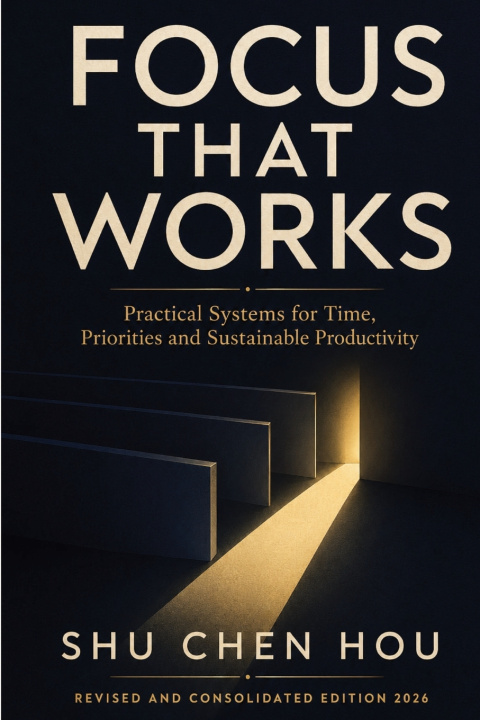
Focus That Works is a practical guide to building a more reliable and sustainable approach to productivity. It is designed for readers who want to make meaningful progress without confusing busyness, long hours or constant availability with valuable work.
Productivity is not the art of filling every minute. It is the practice of directing limited time, attention and energy towards work that matters while protecting recovery, relationships and the unexpected demands of life.
This book begins by redefining productive work. Rather than measuring activity for its own sake, readers learn to identify outcomes, assess genuine contribution and distinguish useful effort from avoidable friction. It also examines the role of clear standards, fair review and capacity-aware planning, showing why self-attack and unrealistic expectations rarely create dependable performance.
The following sections focus on direction, priorities and commitments. Readers are guided through choosing a practical direction, turning broad aims into testable goals, ranking work by consequence and creating a defensible not-to-do list. The emphasis is on making trade-offs visible, reducing unnecessary commitments and deciding what deserves attention now, later or not at all.
The book then develops planning systems that can survive contact with reality. Topics include backwards planning from evidence, using phases and decision gates, building a weekly control point, placing work in time and adapting plans when assumptions change. These methods are intended to make projects clearer and decisions more timely without creating unnecessary bureaucracy.
A substantial section addresses focused execution and attention management. Readers explore single-tasking, switching costs, attention environments, starting friction, deliberate depth and the skill of returning to important work after interruption. The aim is not perfect concentration, but a practical system that makes meaningful work easier to begin, continue and complete.
Focus That Works also considers the everyday systems surrounding productivity. It covers functional workspaces, communication channels, digital information, administrative organisation and routines that serve as useful defaults. The book explains how templates, batches, delegation and automation can reduce repetitive effort while keeping responsibility, quality and human judgement intact.
Sustainable performance is treated as part of productivity rather than an obstacle to it. Readers are encouraged to protect recovery and non-work, plan around changing energy without medicalising ordinary variation, measure progress without creating surveillance and diagnose plateaus through evidence rather than shame. The book recognises that capacity is influenced by health, disability, caring responsibilities, employment conditions, financial pressure and access to resources.
The final section brings these ideas together into a personal operating system. Readers learn how to run small experiments, create daily and weekly control loops, review the whole system and retain only the methods that improve results without creating disproportionate costs elsewhere.
Each chapter concludes with a bounded practical exercise. The book also includes a reusable workbook, a ninety-day practice log and practice-cycle reviews for applying the methods over time.
Grounded, flexible and evidence-aware, Focus That Works is suitable for individual readers, professionals, students, managers, freelancers, creative workers, teams and anyone seeking better time management, prioritisation, concentration and sustainable productivity.
This book provides general educational information and practical exercises. It is not medical, psychological, legal, financial, employment or tax advice.


Informationen zum Buch
Englisch
Kategorie
