
 Kontakt
 Wie einkaufen
Versand
Kaufberater
 Englisch
 39 b
39 b
 Demnächst
 Neu
Neu
Bis zu 30 Tage Rückgaberecht

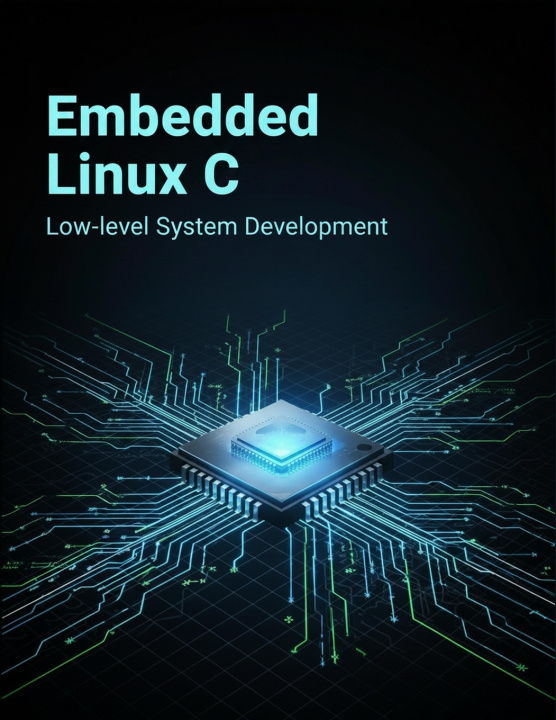
Embedded Linux systems are not abstract exercises in computational theory; they are purpose-built machines operating under severe constraints, where every clock cycle, every byte of memory, and every milliwatt of power matters. For the critical, low-level components of these systems, C remains the undisputed workhorse. Its continued dominance is a direct consequence of its architectural fit and uncompromising efficiency, making it the tactical choice for product performance, reliability, and cost-effectiveness. This book delves into the fundamental arguments for C's indispensability, moving beyond theoretical elegance to address the stark realities of resource-constrained environments and direct hardware control.
This comprehensive guide illuminates C's unvarnished efficiency, translating directly into the raw execution speed and minimal runtime footprint essential for nearly every embedded application. Unlike higher-level languages that abstract away machine details, C provides a direct conduit to the underlying hardware, yielding predictable performance characteristics often unattainable otherwise. You will learn how C compiles directly to machine code, avoiding interpreter or virtual machine overhead, ensuring tight, efficient execution cycles crucial for systems where processing power is measured in MHz and tasks have strict deadlines. The book details how C's lean nature contributes to minimal runtime dependencies, resulting in smaller binary sizes, lower RAM consumption, and faster boot times-all critical metrics for cost-effective and performant embedded Linux products.
Beyond C's inherent advantages, this book navigates the intricate landscape of low-level Linux system development. It explores the crucial user/kernel divide, demystifies undefined behavior in C, and provides practical insights into integer arithmetic and fixed-point precision for embedded systems. Readers will master file descriptors and I/O management, leverage memory mapping for significant performance gains, and understand the nuances of concurrency with processes versus threads. The text offers deep dives into synchronization primitives, race conditions, instruction reordering, and memory barriers, equipping developers to build robust, thread-safe applications.
Key insights you will gain from this book include:
- Mastering C's architectural fit and uncompromising efficiency for resource-constrained embedded Linux environments.
- Understanding predictable execution, minimal runtime overhead, and direct hardware interaction without abstraction layers.
- Navigating the user/kernel divide, advanced memory management techniques, and efficient I/O with poll.
- Deep dives into concurrency, synchronization primitives, and mitigating race conditions for reliable system operation.
- Practical application of inline assembly for direct hardware control and modern Linux service management with systemd.
- Strategies for identifying, diagnosing, and preventing common failure patterns in embedded C development.
"Embedded Linux C: Low-Level System Development" is an essential resource for engineers and developers seeking to build, optimize, and maintain high-performance, reliable embedded Linux systems. It provides the foundational knowledge and advanced techniques required to harness C's full power in the demanding world of embedded systems.


Informationen zum Buch
Englisch

Verschenken Sie dieses Buch noch heute
Es ist ganz einfach
1 Legen Sie das Buch in Ihren Warenkorb und wählen Sie den Versand als Geschenk 2 Wir schicken Ihnen umgehend einen Gutschein 3 Das Buch wird an die Adresse des beschenkten Empfängers geliefertHallo! Ich bin Libroamiko, dein Buchberater.
Wie kann ich dir helfen?