
 Kontakt
 Wie einkaufen
Versand
Kaufberater
Blind Speech Separation
 Englisch
 394 b
394 b
30 Tage für die Rückgabe der Ware
Kunden kauften auch



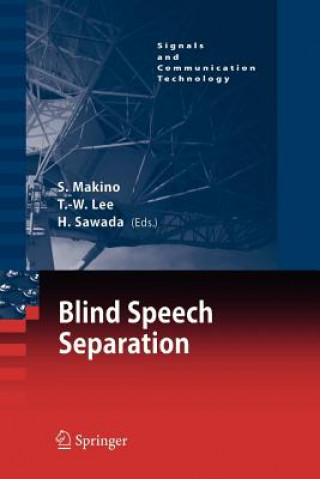
This is the world s first edited book on independent component analysis (ICA)-based blind source separation (BSS) of convolutive mixtures of speech. This book brings together a small number of leading researchers to provide tutorial-like and in-depth treatment on major ICA-based BSS topics, with the objective of becoming the definitive source for current, comprehensive, authoritative, and yet accessible treatment.This is the first book to provide a cutting edge reference to the fascinating topic of blind source separation (BSS) for convolved speech mixtures. Through contributions by the foremost experts on the subject, the book provides an up-to-date account of research findings, explains the underlying theory, and discusses potential applications. The individual chapters are designed to be tutorial in nature with specific emphasis on an in-depth treatment of state of the art techniques.§Blind Speech Separation is divided into three parts:§Part 1 presents overdetermined or critically determined BSS. Here the main technology is independent component analysis (ICA). ICA is a statistical method for extracting mutually independent sources from their mixtures. This approach utilizes spatial diversity to discriminate between desired and undesired components, i.e., it reduces the undesired components by forming a spatial null towards them. It is, in fact, a blind adaptive beamformer realized by unsupervised adaptive filtering.§Part 2 addresses underdetermined BSS, where there are fewer microphones than source signals. Here, the sparseness of speech sources is very useful; we can utilize time-frequency diversity, where sources are active in different regions of the time-frequency plane.§Part 3 presents monaural BSS where there is only one microphone. Here, we can separate a mixture by using the harmonicity and temporal structure of the sources. We can build a probabilistic framework by assuming a source model, and separate a mixture by maximizing the a posteriori probability of the sources.


Informationen zum Buch
Englisch
Kategorie

Verschenken Sie dieses Buch noch heute
Es ist ganz einfach
1 Legen Sie das Buch in Ihren Warenkorb und wählen Sie den Versand als Geschenk 2 Wir schicken Ihnen umgehend einen Gutschein 3 Das Buch wird an die Adresse des beschenkten Empfängers geliefertDas könnte Sie auch interessieren












Hallo! Ich bin Libroamiko, dein Buchberater.
Wie kann ich dir helfen?