
 Kontakt
 Wie einkaufen
Versand
Kaufberater
 Englisch
 192 b
192 b
 Neu
Neu
Bis zu 30 Tage Rückgaberecht

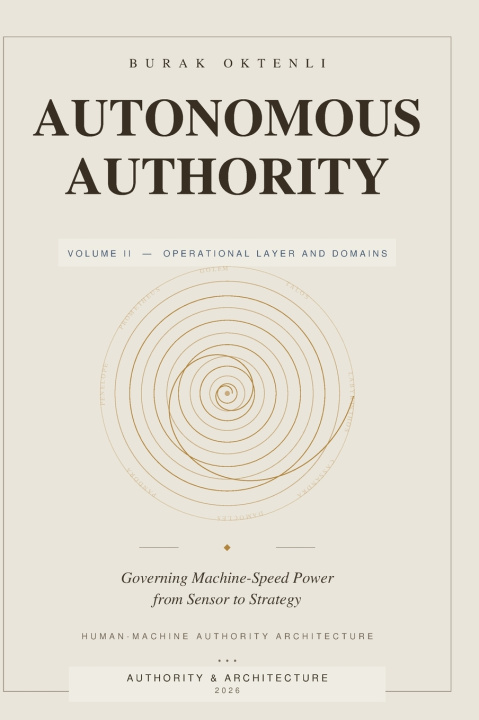
When authority migrates from human deliberation to machine-speed computation, the question is no longer whether autonomous systems will govern themselves, but how. Autonomous Authority Volume II: Operational Layer and Domains specifies what the Human-Machine Authority Architecture (HMAA) demands of each contemporary operational domain: orbital, cyber, allied, cognitive, and extraterrestrial. The answer is not a single architecture. It is fourteen.
The book opens with five chapters of operational analysis: four-archetype convergence (distributed swarm, cognitive denial, orbital denial, economic coercion); the doctrinal primacy of temporal compression in machine-speed conflict; the E_econ revolution that promotes economic coupling to a primary governance variable; the G-variable in field practice; and the novel theoretical concepts that emerge when the model is tested against empirical data.
It then specifies the full domain stack across fourteen chapters covering orbital, cyber, allied, cognitive, and extraterrestrial authority; runtime hardware enforcement; multi-physics coupling; temporal lifecycle decay; swarm emergence and recursive self-improvement boundaries; verifiable autonomy; distributed multi-stakeholder computation; counter-autonomy against adversarial AI; and quantum-resilient cryptographic foundations.
Four case-study appendices anchor the framework against the historical record: the 2008 financial crisis as authority failure in autonomous economic systems, the September 11 attacks as a pre-autonomous authority failure, the pharmacological kill chain in civilian recommender architectures, and a consolidated technical reference.
Written for defense planners, autonomous systems engineers, AI governance researchers, and policy professionals working at the frontier of machine-speed decision making, the book bridges formal theory and operational doctrine. It treats authority not as a political concept to be debated but as an engineering quantity to be specified, computed, and verified.
Fourteen domains. Four failure modes. One architecture.


Informationen zum Buch
Englisch

Verschenken Sie dieses Buch noch heute
Es ist ganz einfach
1 Legen Sie das Buch in Ihren Warenkorb und wählen Sie den Versand als Geschenk 2 Wir schicken Ihnen umgehend einen Gutschein 3 Das Buch wird an die Adresse des beschenkten Empfängers geliefertHallo! Ich bin Libroamiko, dein Buchberater.
Wie kann ich dir helfen?