
 Kontakt
 Wie einkaufen
Versand
Kaufberater
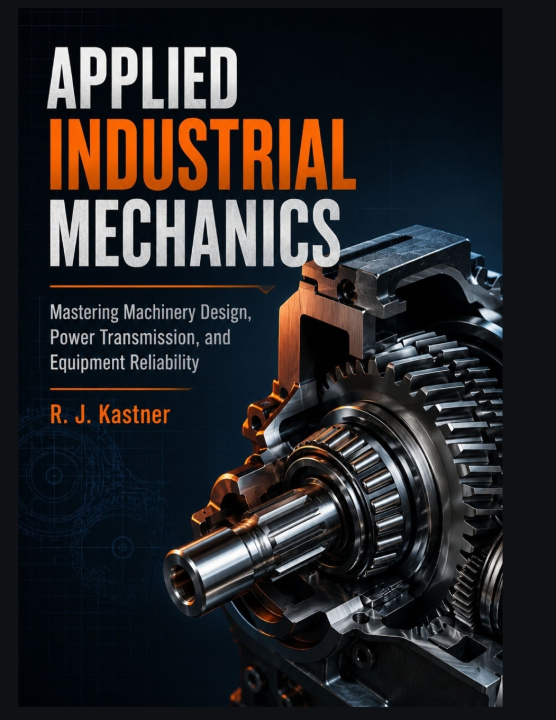
APPLIED INDUSTRIAL MECHANICS
Mastering Machinery Design, Power Transmission and Equipment Reliability
 Englisch
 212 b
212 b
 Neu
Neu
Bis zu 30 Tage Rückgaberecht

A shaft sized correctly on paper and a shaft that fails on the plant floor eighteen months later are, more often than not, the same shaft, examined from two different chairs, using two bodies of knowledge that rarely talk to each other.
Most engineers and technicians learn machine design and industrial maintenance as separate subjects. A design text explains how to size a shaft, select a bearing, or specify a gear ratio, then stops once the component leaves the drawing board. A maintenance reference picks up only after that same component is installed and starts wearing or failing, often without tracing the failure back to the design decision that set it in motion.
This book closes that gap with one continuous reference, moving from mechanics fundamentals through the individual machine-element families that make up industrial equipment, to the vibration, alignment, and reliability practices that determine how long a correctly designed machine actually lasts in service. Every chapter carries a worked example's units through every step, in SI units with US customary equivalents alongside, and every practice problem includes a checkable, boxed answer.
Inside, readers will practice how to:
- Construct free-body diagrams and apply stress, strain, and failure-theory calculations to real machine components, with every step shown in full.
- Size and select shafts, keys, couplings, rolling-element and hydrodynamic bearings, gear sets, and belt, chain, and wire-rope drives for a specified load and service life.
- Work through hydraulic and pneumatic circuit fundamentals as they apply to industrial actuation and power transmission, and size clutches and brakes for real transmission-control tasks.
- Read vibration spectra, recognize common fault patterns such as imbalance, misalignment, and looseness, and align rotating machinery.
- Apply reliability metrics, including mean time between failures, mean time to repair, and Weibull analysis, to plan realistic maintenance intervals.
- Use condition-monitoring techniques, including oil analysis, thermography, ultrasonic inspection, and motor current signature analysis, within a structured predictive maintenance program.
- Apply failure mode and effects analysis and root cause analysis methods to diagnose recurring equipment problems, supported throughout by a glossary, symbol list, and appendices covering unit conversions, material properties, and standards references.
Begin building a connected understanding of how machines are designed, sized, and kept running.
Get your copy and start working through the mechanics, machine elements, and reliability practices that turn a well-designed component into a machine that keeps running.


Informationen zum Buch
Englisch

Verschenken Sie dieses Buch noch heute
Es ist ganz einfach
1 Legen Sie das Buch in Ihren Warenkorb und wählen Sie den Versand als Geschenk 2 Wir schicken Ihnen umgehend einen Gutschein 3 Das Buch wird an die Adresse des beschenkten Empfängers geliefertHallo! Ich bin Libroamiko, dein Buchberater.
Wie kann ich dir helfen?